
Blog
What the Estate Tax Exemption Sunset Reversal Means for San Francisco Business Valuation in 2026
The feared 2026 estate tax exemption sunset never happened: Congress fixed the federal exclusion at $15 million per person instead of letting it collapse. Here's why San Francisco business owners with growing companies still need a current, qualified valuation to use that new headroom before the rules change again.
For the past several years, every estate planning conversation with a privately held business owner started the same way: the Tax Cuts and Jobs Act exemption was temporarily doubled, it was scheduled to expire after 2025, and the exclusion was going to fall back to roughly half its size. That cliff did not happen. Congress rewrote the rule before it took effect, and the practical question for San Francisco business owners is no longer "how do I survive the sunset," it's "how do I use the new, permanent exemption before my company's value outgrows it."
The Sunset That Never Arrived
Under the 2017 tax law, the federal basic exclusion amount, the dollar value an individual can pass free of federal estate and gift tax, was temporarily doubled from its prior statutory level. That doubling was written to expire on December 31, 2025. Absent new legislation, the exclusion would have reverted for 2026 to the pre-2018 amount adjusted for inflation, a figure many advisors estimated near $7 million per person, down from $13,990,000 in 2025.
That drop worried business owners for a straightforward reason: a company valued comfortably under the exemption in 2024 could suddenly push an estate over the line in 2026, triggering a federal estate tax liability of up to 40% on the excess. Owners of fast-growing San Francisco companies, tech, professional services, real estate-adjacent businesses, spent two years being told to gift shares now or lose the larger exemption forever.
What Public Law 119-21 Actually Changed
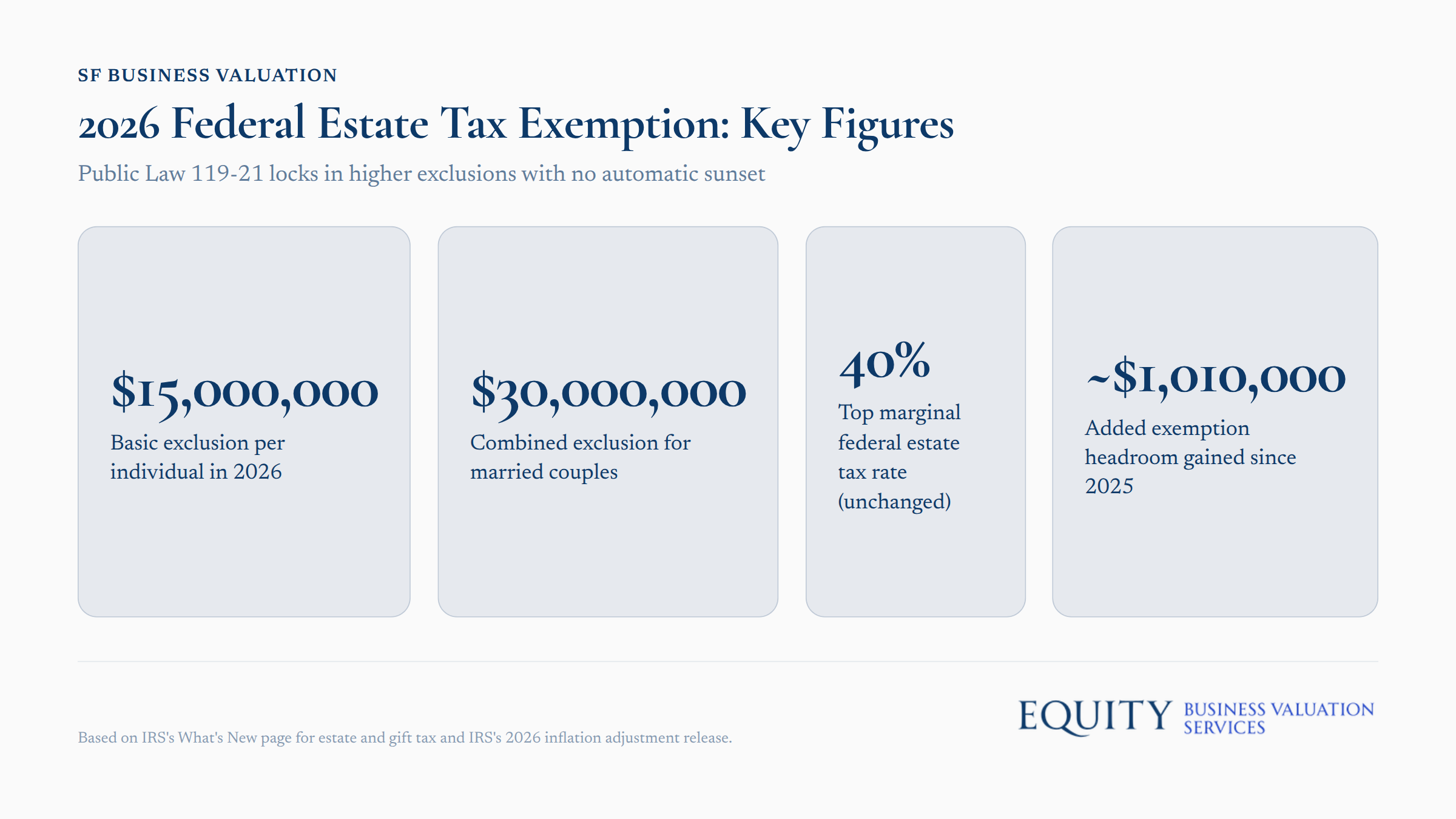
Congress did not let the exemption fall. The Working Families Tax Cuts Bill, signed into law in 2025, amended the exclusion provisions of the tax code and set the 2026 basic exclusion amount at $15,000,000 per individual, or $30,000,000 for a married couple using both spouses' exemptions, with inflation adjustments continuing in the years after 2026, as confirmed on the IRS's What's New page for estate and gift tax. The IRS's 2026 inflation adjustment release confirms the same figure and the ongoing inflation mechanism.
The federal estate tax rate itself did not change. The top marginal rate remains 40%, and the exemption still shelters the entire taxable estate, business interests, real estate, securities, and personal property alike, up to the exclusion amount, not a separate allowance per asset. There is no new sunset written into current law. The $15 million figure is permanent unless a future Congress votes to change it again, a meaningfully different posture than the automatic 2026 cliff that was on the books for years.
Why This Still Creates Urgency for San Francisco Business Owners
Permanent does not mean static. The exclusion still climbs with inflation every year, and that annual increase is exactly where the opportunity, and the time pressure, lives for an owner who has already used some exemption through prior gifts or a prior valuation.
The move from the 2025 exclusion of $13,990,000 to the 2026 figure of $15,000,000 is roughly $1,010,000 of fresh headroom per person, confirmed by the IRS inflation adjustment announcement. That additional room is only usable against a gift of business equity if the gift is properly valued and documented at the time it's made. An owner who gifted shares in 2023 using that year's exemption doesn't automatically get to apply the new 2026 room to the same shares retroactively. The new headroom has to be used against a current transfer, valued as of a current date.
Key takeaway: The exemption increase is not a reason to wait. It's a reason to revalue and act, because the additional exclusion only offsets a gift made and appraised this year, not a transfer completed years ago.
For owners weighing whether their company's value and their available exemption still line up, our IRS-qualified business valuation services walk through exactly how a fair market value conclusion feeds into Form 706 and Form 709 planning.
The Risk: A Fast-Growing Company Can Outgrow the Exemption
San Francisco's concentration of technology, professional services, and real estate-adjacent businesses means company values can move faster than the tax code does. A business valued at $8 million in 2023 that doubles revenue and enterprise value by 2027 can consume a married couple's entire $30 million combined exemption on its own, especially once other assets, real estate, investment accounts, retirement plans, are added to the estate.
Example: A married San Francisco couple owns a software consultancy valued at $4 million in 2024 and has made no prior taxable gifts. By 2027, after two years of 35% annual growth driven by recurring contracts, the same ownership interest is worth closer to $7.3 million. The exemption available to shelter that interest hasn't changed much over the same period, but the asset consuming it has grown by more than 80%. An owner who waits for the business to plateau before gifting shares risks giving away a much larger taxable value than if the transfer had been made, and appraised, earlier.
This is the practical argument for pairing growth-stage business planning with a current valuation rather than treating the estate tax exemption as settled and the business's value as something to revisit later.
Lock In Value Now: Lifetime Gifting as a Hedge
Congress changed the exemption once already during the life of the TCJA provisions, first by doubling it, then by making the increase permanent instead of letting it lapse. A future Congress retains that same authority and could lower the exclusion again, particularly as federal deficit and revenue debates continue. Because the exemption is unified across lifetime gifts and transfers at death, a gift made today consumes exemption at today's value; it does not get revalued upward if the business appreciates further, and it is not exposed if a future Congress reduces the exclusion before the owner dies.
That asymmetry is why gifting appreciating business equity during life, supported by a defensible, dated valuation, functions as a hedge against both business growth and legislative risk. The business's value is locked in at the date of the gift; any appreciation after that date happens outside the donor's taxable estate.
Watch out: A gift of business equity without a contemporaneous, qualified appraisal is one of the most common triggers for an IRS challenge on audit. The IRS examination guidance for gift and estate valuation issues makes clear that the agency expects supportable, well-documented fair market value conclusions, not informal estimates, as outlined in the IRS's estate and gift tax guidance.
California Has No Estate Tax, But Federal Rules Still Apply in Full
California does not impose a separate state estate or inheritance tax, so a San Francisco business owner's primary death-transfer tax exposure is federal. That doesn't simplify the planning as much as it might sound. California's community property rules still determine how a married owner's business interest is characterized, and that characterization affects how much of the interest is includible in each spouse's estate and how gifting or basis planning should be structured.
For a married business owner, the valuation and the ownership characterization need to be worked out together, not sequentially. Our guide on how California's community property rules intersect with business valuation covers the mechanics of how ownership interests are split and characterized, concepts that carry over directly into estate and gift planning for a married founder or principal.
Federal rules that remain fully in effect regardless of California's lack of a state estate tax include the alternate valuation date election under Internal Revenue Code Section 2032, the special-use valuation provisions under Section 2032A for qualifying real property used in a trade or business, and the installment payment option under Internal Revenue Code Section 6166, which allows an estate to pay the portion of estate tax attributable to a closely held business in installments when that business exceeds 35% of the adjusted gross estate.
What a Defensible Business Valuation for Form 706 or Form 709 Must Cover
A valuation prepared for an estate or gift tax filing has to do more than produce a number; it has to withstand IRS scrutiny years after the transfer date. The IRS Form 706 instructions describe the valuation date requirements and the alternate valuation election, but the substance of what makes a business valuation defensible comes from longstanding IRS guidance on how fair market value is determined for closely held interests.
A complete report addresses each of the following:
- Fair market value as of the valuation date: the price a willing buyer and willing seller would agree to, neither under compulsion, both reasonably informed, measured on the date of the gift or the date of death (or the alternate valuation date if properly elected).
- Control versus minority interest: whether the interest being valued carries voting control and management authority, or represents a minority, non-controlling position, since that distinction materially changes value.
- Discounts for lack of control and lack of marketability: reductions applied when the interest cannot direct company decisions or cannot be readily sold, each of which must be supported by company-specific facts rather than applied as a flat industry rule of thumb.
- Documentation standards: the valuation must show its methodology, the financial data relied upon, comparable company or transaction analysis where applicable, and the reasoning behind any discounts, consistent with the fair market value framework the IRS has applied to closely held business valuations since Revenue Ruling 59-60.
Appraisers preparing these reports typically hold credentials with organizations such as the ASA and NACVA, and reports are built to be consistent with the standards published by The Appraisal Foundation under USPAP. Those standards exist precisely because estate and gift tax valuations face more scrutiny, and carry more financial consequence, than an informal estimate ever could.
Revalue Before the Next Change, Not After
The 2026 exemption increase removed an immediate threat, but it didn't remove the underlying problem: business values move, tax law changes on its own schedule, and the only way to use today's exemption against today's value is to document that value today. A San Francisco owner sitting on an appreciating company has more room to work with in 2026 than in 2025, and less certainty about how much room will exist five years from now.
If you're weighing a lifetime gift, an estate plan update, or a Form 706 filing for a business interest, our team prepares USPAP-compliant business valuations built for IRS scrutiny. Request a business valuation to get a fixed-fee quote scoped to your company and your filing deadline.
This article is provided for general informational purposes only and does not constitute legal, tax, or financial advice. Readers should consult a qualified attorney or CPA regarding their specific circumstances.