
Blog
IRS Qualified Business Valuation and Estate Tax Rules for San Francisco Owners
California has no state estate tax, but a closely held San Francisco business can still push an estate over the federal exemption line. Here is when Form 706 requires an IRS-qualified business valuation and what that appraisal must contain.
California has not collected a state estate tax since 2005, so many families assume estate tax is simply not a San Francisco problem. That assumption gets tested the moment a decedent owned a closely held business, a professional practice, a multi-location restaurant group, a tech services firm, or a real estate holding LLC, because business value in this market runs high enough to bump an otherwise modest estate against the federal exemption. This guide walks executors, trustees, attorneys, and CPAs through when a qualified appraisal is actually required and what the IRS expects it to contain.
California Has No Estate Tax, But the Federal Rule Still Applies
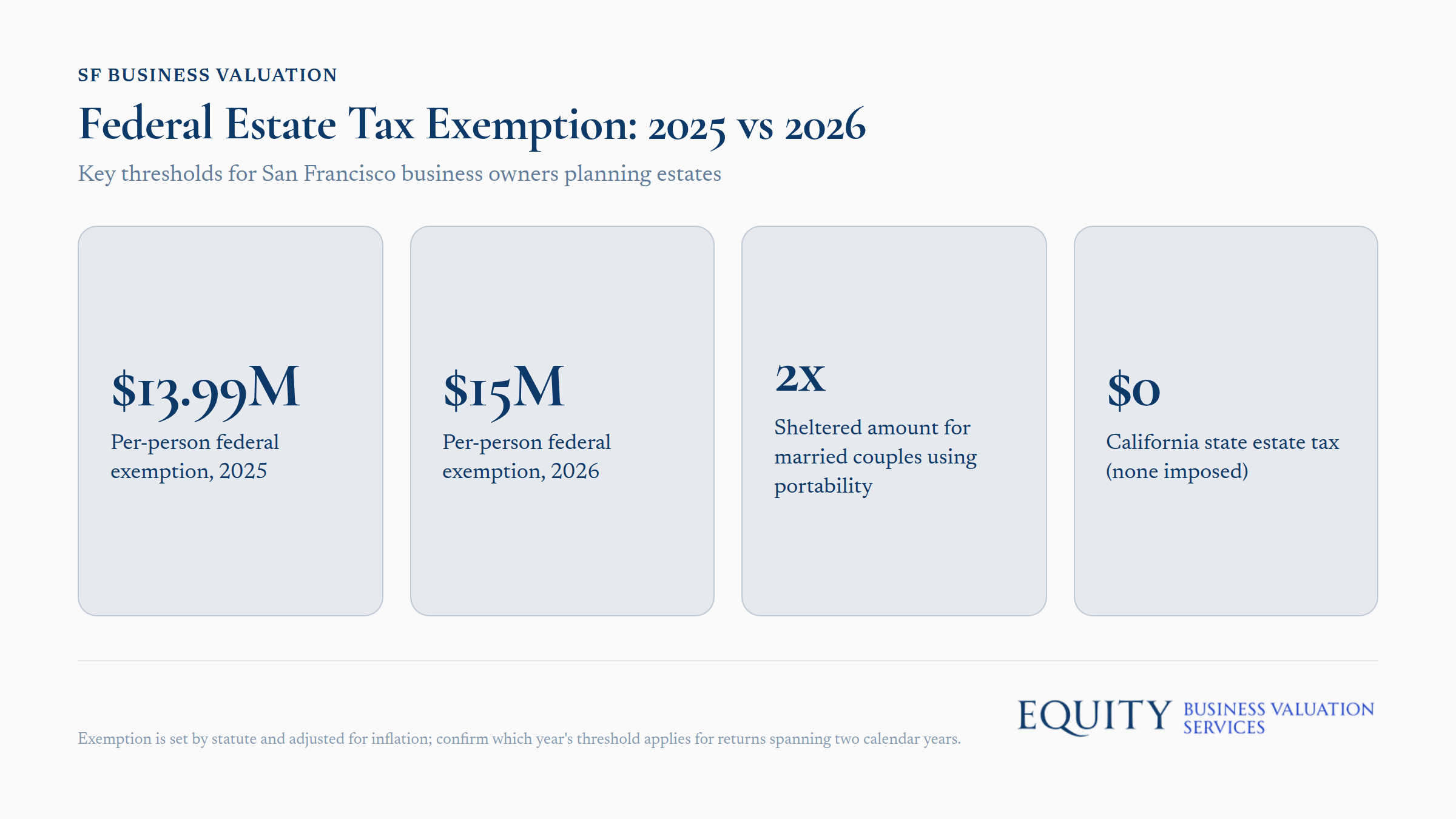
California repealed its inheritance tax back in 1982, and it stopped requiring a state estate tax return for anyone dying on or after January 1, 2005, when the federal state death tax credit that funded it was eliminated. There is no California death tax return to file and no state exemption threshold to track.
That does not mean California estates are exempt from tax planning. The federal estate tax still applies to any resident's estate, and San Francisco's business values, real estate, and investment portfolios are large enough that federal exposure is a real planning issue even without a state-level tax. Families who assume "no state estate tax" means "no estate tax questions" are usually the ones who get surprised. Our business valuation services exist specifically for the estates where a closely held company is the asset most likely to trigger that surprise.
The Federal Estate Tax Exemption in 2025 and 2026
The federal estate and gift tax exemption is $13.99 million per person for 2025 and rises to $15 million per person for 2026. A married couple who both use their exemption effectively shelters double that amount, assuming proper portability elections are filed.
Those numbers sound generous until you total a San Francisco estate that includes a home, retirement accounts, and a business interest. A single professional practice or restaurant group valued at $5 million to $8 million, combined with a Bay Area residence and a typical investment account, can land an estate within striking distance of the exemption even in years when the exemption itself is rising. The exemption is scheduled by statute and adjusts for inflation, so executors working on a return that spans two calendar years need to confirm which year's threshold governs the filing.
Why a Closely Held San Francisco Business Pushes Estates Over the Line
Small business value concentrates wealth in ways that public markets don't. A restaurant group with three locations, a dental practice with a loyal patient base, or a tech services firm with recurring contracts can carry substantial goodwill value that never shows up on a balance sheet at book value. Real estate holding LLCs add another layer, since the entity's reported basis on the decedent's books often understates current fair market value by a wide margin.
This is exactly why the IRS does not let executors report a business interest at whatever figure feels reasonable. Once the estate includes a privately held company, the return needs the same rigor as any other major asset class, and that means an independent, credentialed opinion of value rather than an internal estimate from the family accountant or a rule-of-thumb multiple pulled from an industry survey.
When Form 706 Is Required, and Why You Might File It Anyway
Executors must file IRS Form 706 when the gross estate, plus adjusted taxable gifts, exceeds the applicable exemption amount for the year of death. Below that threshold, filing is optional, but many estate attorneys recommend filing anyway to lock in the stepped-up basis on appreciated assets and to start the statute of limitations running on the IRS's ability to challenge the reported values later.
That second reason matters more than most families realize. Without a filed return establishing basis and value, the IRS can revisit the estate's valuation positions indefinitely when heirs eventually sell the business or its underlying assets. A qualified appraisal filed with a protective Form 706, even for an estate well under the exemption, closes that door.
What a Qualified Appraisal Must Include for a Business Interest
When the estate includes a partnership interest or an unincorporated business, the executor must attach a statement of assets and liabilities as of the valuation date, along with net earnings statements covering the valuation date and the prior 5 years, plus the entity's employer identification number. The valuation itself must account for goodwill and generally follows the same analytical approach used to value close corporation stock: examining earnings history, tangible and intangible assets, and any comparable transaction data available.
Our team's approach to how a small business is valued mirrors this same framework for closely held San Francisco companies, weighing earnings capacity, tangible assets, and market comparables together rather than relying on a single shortcut multiple.
How the IRS Weighs the Evidence
The foundational IRS guidance for valuing a closely held business without an active trading market is Revenue Ruling 59-60. It directs the appraiser to weigh a specific set of factors together rather than pick one and ignore the rest:
- The nature of the business and the history of the enterprise from its inception
- The economic outlook in general and the outlook of the specific industry in particular
- The book value of the stock and the financial condition of the business
- The company's earning capacity and dividend-paying capacity
- Whether the enterprise has goodwill or other intangible value
- Prior sales of the stock and the size of the block being valued
- The market price of stocks of corporations engaged in a similar line of business
A report that skips this framework, or that reduces the analysis to a single earnings multiple, is exactly the kind of appraisal that draws IRS scrutiny on audit.
Who Counts as a "Qualified Appraiser" Under IRS Rules
The IRS does not accept an opinion of value from just anyone with a calculator. A qualified appraiser has to hold relevant credentials or demonstrable experience, regularly perform appraisals of that property type for compensation, and remain independent of the estate, meaning no family relationship to the decedent or financial stake in the outcome.
For a business interest, that typically means an appraiser working under standards set by organizations such as the American Society of Appraisers (ASA) or NACVA, and every credible report should state that it was prepared in accordance with USPAP (the Uniform Standards of Professional Appraisal Practice, published by The Appraisal Foundation). An appraisal from an appraiser who does not meet these tests can be disregarded by the IRS even if the underlying math is sound.
The Cost of Getting the Value Wrong
Undervaluing a business interest to reduce the taxable estate is not a victimless shortcut. Understating a reported value can trigger accuracy-related penalties against the estate, and appraisers who knowingly aid an understatement face their own separate penalty exposure from the IRS. Overvaluing an asset carries risk too, since it can inflate the tax bill unnecessarily or create inconsistencies if the same business is later reported at a lower value for a sale or a gift.
Watch out: A "friendly" valuation from someone close to the family, or a figure backed into from a target tax outcome rather than independent analysis, is one of the fastest ways to invite an IRS challenge on audit.
A Worked Example: A San Francisco Restaurant Group Estate
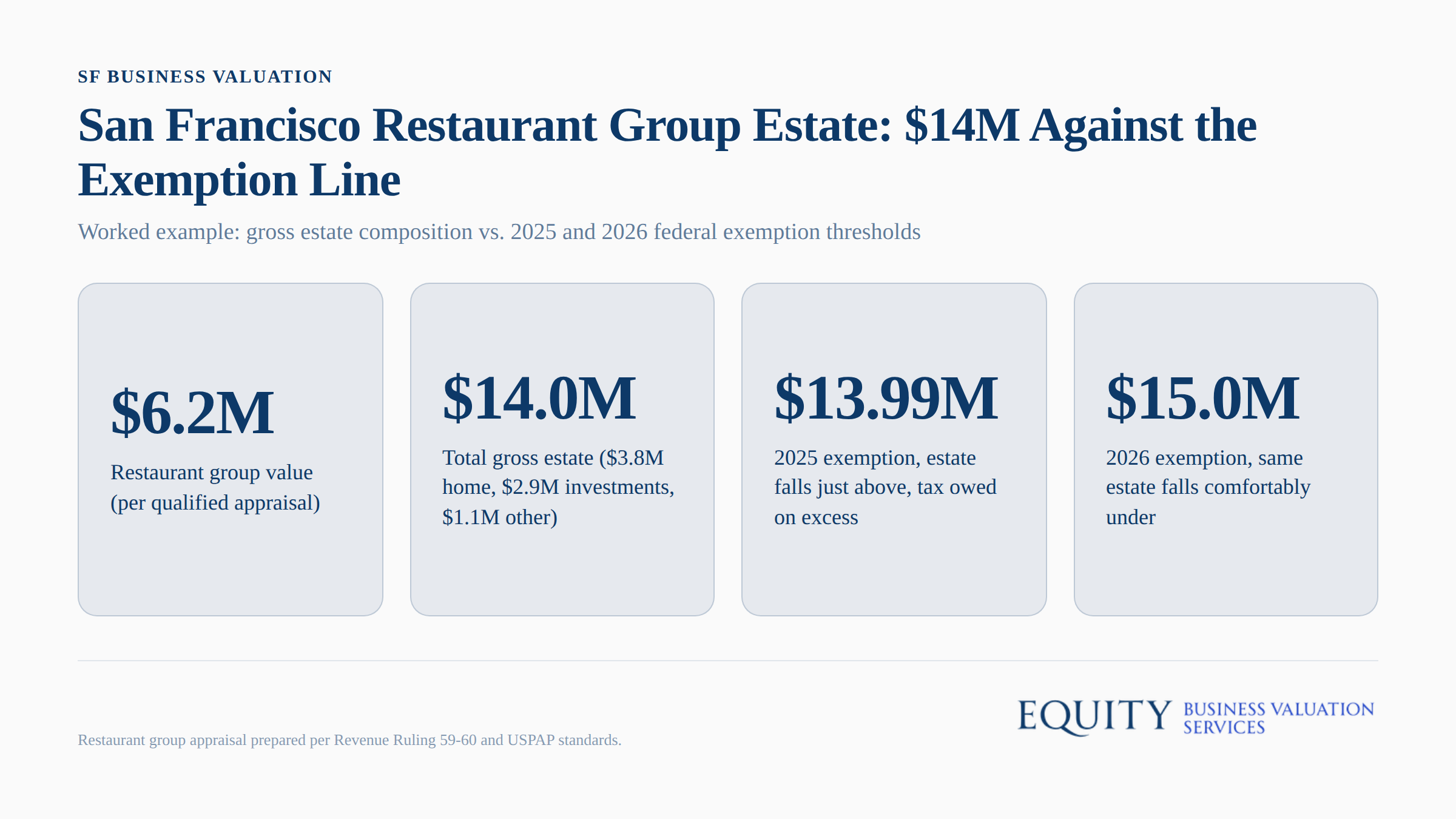
Consider an estate where the decedent owned a three-location specialty restaurant group in San Francisco, along with a home, an investment account, and a life insurance payout. Here is how the pieces stack up against the exemption line in each filing year.
| Asset | Reported Value |
|---|---|
| Restaurant group (per qualified appraisal) | $6,200,000 |
| San Francisco residence | $3,800,000 |
| Investment accounts | $2,900,000 |
| Life insurance and other assets | $1,100,000 |
| Total gross estate | $14,000,000 |
Against the 2025 exemption of $13.99 million, this estate sits just above the line and owes federal estate tax on the excess. Against the 2026 exemption of $15 million, the same estate falls comfortably under the threshold. The restaurant group's appraised value is the single largest and most contestable line item, and it is also the one asset class where the IRS is most likely to ask for support. A qualified appraisal, prepared to Revenue Ruling 59-60 and USPAP standards, is the documentation that stands behind the number if the IRS ever opens an inquiry, whether that happens in the year the return is filed or a decade later when the heirs sell the business.
Our firm's engagements for estate and gift tax purposes are quoted as a fixed fee once we understand the entity structure and the number of years of financial records involved. IRS-qualified business valuations for estate filings typically start at $5,500, with most closely held San Francisco businesses landing in the $7,500 to $12,000 range depending on entity complexity and the depth of financial history available. Engagements are always quoted before work begins and never billed hourly.
California vs. Federal Estate Tax: Quick Reference
| California | Federal | |
|---|---|---|
| State estate tax return required | No, repealed for deaths on or after January 1, 2005 | N/A |
| State inheritance tax | No, repealed in 1982 | N/A |
| Exemption amount (2025) | Not applicable | $13.99 million per person |
| Exemption amount (2026) | Not applicable | $15 million per person |
| Filing trigger | None | Gross estate plus adjusted taxable gifts exceeds the exemption |
| Appraisal requirement for closely held business | Not applicable | Qualified appraisal required to support Form 706 value |
Executors handling a San Francisco estate should treat this table as a starting point, not a substitute for reviewing the actual asset mix with an estate attorney and, where a business interest is involved, an appraiser who works in these engagements regularly.
Getting the Valuation Right Before You File
An estate that includes a closely held San Francisco business needs more than a plausible number on Form 706. It needs a qualified appraisal built on the factors the IRS itself has laid out, prepared by an appraiser independent of the family and credentialed to do the work. Whether the estate ultimately owes federal tax or simply wants a documented basis on file, that report is the asset that protects the family long after the return is filed.
If you are an executor, trustee, or advisor preparing a Form 706 that includes a closely held business interest, our team can scope an IRS-qualified appraisal and provide a fixed-fee quote. Request an appraisal to get started.
This article is provided for general informational purposes only and does not constitute legal, tax, or financial advice. Readers should consult a qualified attorney or CPA regarding their specific circumstances.