
Blog
Business Valuation in a California Divorce: How Community Property Splits a San Francisco Business
Business valuation in a California divorce turns on when the business grew, not just what it's worth today. This guide explains the community property rules, the date-of-separation pivot, and how Pereira and Van Camp apportion growth between spouses.
California divorces don't split a business the way most of the country does. Because California is a community property state, the question isn't "what's fair" in the abstract; it's a formula-driven exercise in tracing when value was created and by whom. For a San Francisco business owner going through a divorce, understanding that formula matters as much as understanding what the business is worth.
This is where business valuation work and family law intersect. A credentialed appraiser can put a defensible number on the business, but California's community property statutes and case law determine how that number gets divided between spouses. Get the legal framework wrong and even a perfect valuation report won't produce a fair settlement.
California Is a Community Property State, Not an Equitable Distribution State
California is one of a small number of states that treats marriage as an economic partnership from day one, which means property acquired during the marriage is presumed to belong to both spouses equally, regardless of whose name is on the title or who did the work.
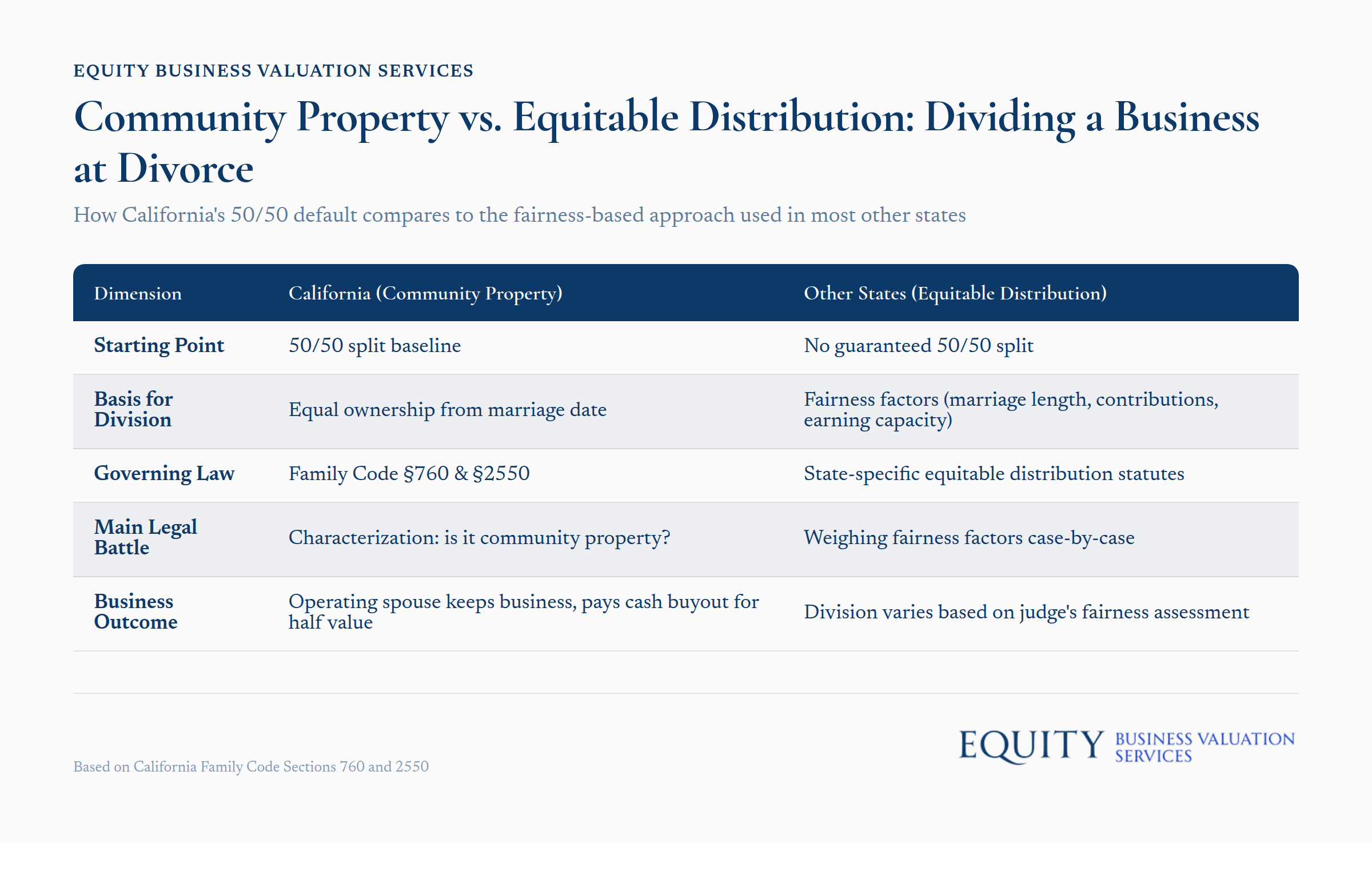
Under California Family Code Section 760, "all property, real or personal, wherever situated, acquired by a married person during the marriage while domiciled in this state is community property." A business founded, grown, or acquired during the marriage falls squarely under that presumption. At divorce, Family Code Section 2550 requires the court to divide the community estate equally, which in practice means the operating spouse usually keeps the business and pays the other spouse a cash buyout equal to half its community value.
Most other states use equitable distribution instead. In an equitable distribution state, the court divides marital property based on what's fair under a list of factors (length of marriage, each spouse's contributions, earning capacity), and a 50/50 split isn't guaranteed or even the default. In California, community property starts from a 50/50 baseline and the real fight is almost always about characterization: is this business, or this slice of its growth, community property at all?
Why the Date of Separation Matters More Than the Filing Date
The date of separation, not the date the divorce petition is filed and not the trial date, is the line that generally separates community property from separate property in California. Earnings and business growth after that date are typically treated as separate property belonging to the spouse who generated them.
California Family Code Section 70 defines the date of separation as the point when there has been "a complete and final break in the marital relationship," shown by both a spouse's intent to end the marriage and conduct consistent with that intent. Living in the same house, filing taxes jointly, or even attending counseling after that date doesn't necessarily reset the clock, but the courts look at the full pattern of behavior, not a single moving-out date.
This matters enormously for a business owner. A San Francisco founder who separates from their spouse in January but doesn't file for divorce until the following year has, in theory, an entire year of business growth that may already be separate property, even though the case hasn't officially started. Getting the timing right in a business valuation often depends on pinning down this date before the appraiser ever opens the company's books.
Watch out: Couples sometimes disagree sharply about the date of separation because it changes which spouse gets credit for years of business growth. This is frequently litigated on its own, separate from the valuation itself, and the outcome directly changes what an appraiser is asked to value and as of when.
What Happens When a Separate-Property Business Grows During the Marriage
When a business existed before the marriage but increases in value while the couple is married, California law splits that growth into a community portion and a separate portion rather than treating the whole increase as one or the other. This apportionment exercise is one of the more technical pieces of a California divorce business valuation, and it's where an experienced appraiser and family law attorney need to work in lockstep.
The business itself, and its value as of the date of marriage, generally stays the owner-spouse's separate property under Family Code Section 770. But the appreciation that happens during the marriage is fair game for the community, at least in part, because marital labor and often marital funds contributed to that growth.
Pereira vs Van Camp: Two Ways to Split the Growth
California courts use one of two long-standing formulas to apportion that growth: the Pereira method or the Van Camp method. Which one applies depends on what actually drove the business's increase in value.
Pereira (Pereira v. Pereira, 1909) applies when the growth is mainly attributable to the owner-spouse's personal skill, effort, and management rather than the business's capital or market conditions. Courts still cite Pereira as controlling law for this fact pattern in modern California business valuation disputes. Under Pereira:
- The business's fair market value on the date of marriage is fixed as the starting point.
- A reasonable rate of return is applied to that starting value for each year of the marriage.
- The original value plus that imputed return stays separate property.
- Everything above that amount is treated as community property, because it's presumed to reflect the owner-spouse's marital-era labor.
Van Camp (Van Camp v. Van Camp, 1921) applies when growth is mainly attributable to the nature of the business itself: its capital base, its workforce, brand strength, or market conditions, rather than one spouse's personal effort. Under Van Camp:
- The court sets a reasonable salary for the owner-spouse's services over the years of the marriage.
- That reasonable salary, minus whatever compensation the spouse actually took out of the business (salary, distributions), becomes the community's claim.
- The remaining business value stays separate property.
Both methods are still the default framework California courts reach for in mixed-character businesses. Choosing between them is often the single biggest lever in the outcome of a business valuation divorce California case, because the two formulas can produce very different community shares from the exact same set of underlying numbers.
Worked Example: Pereira vs Van Camp on the Same Business
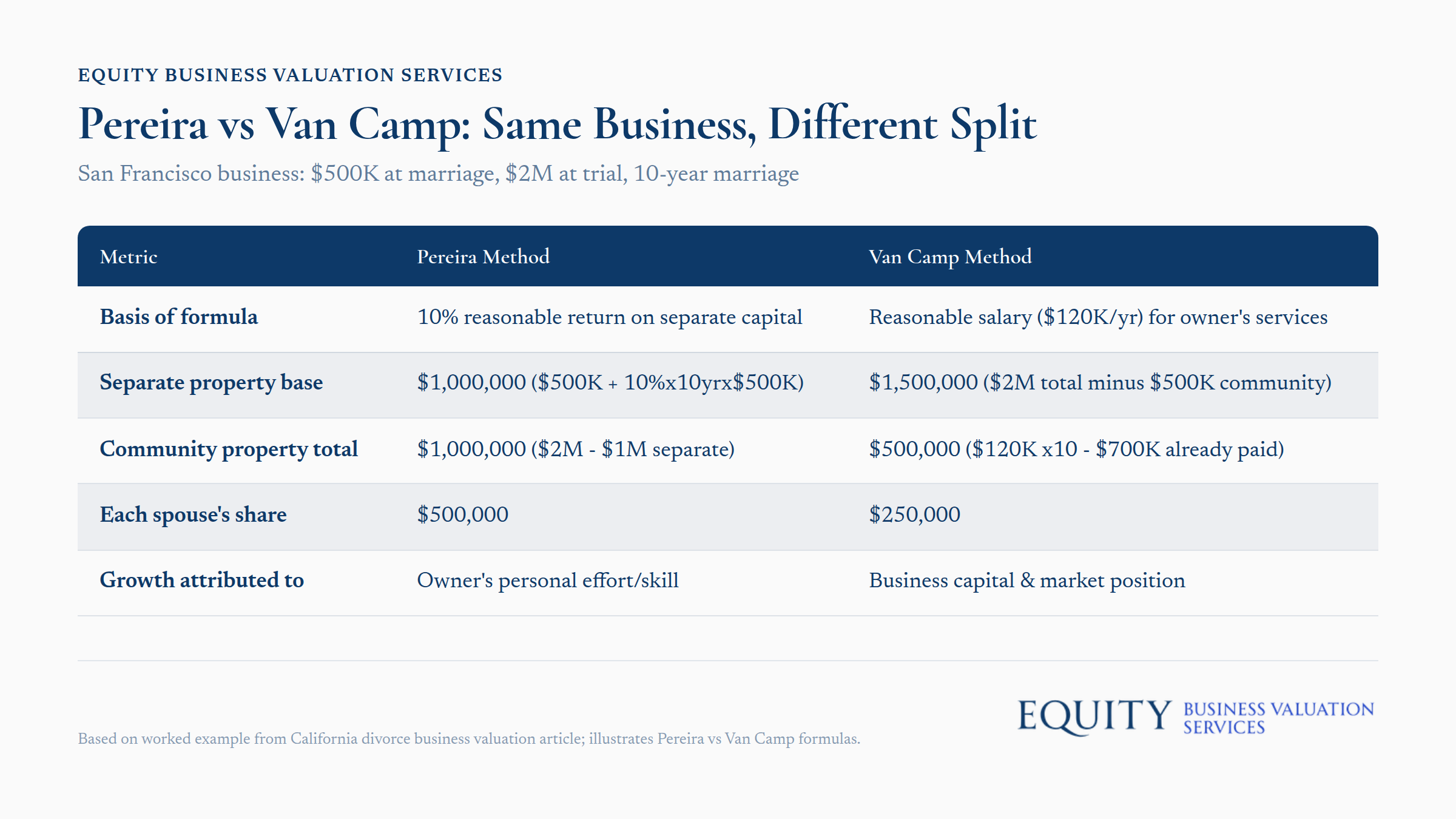
Example: A San Francisco business owner starts a company 2 years before getting married. At the date of marriage, the business is worth $500,000. The marriage lasts 10 years, and at the time of trial, the business is worth $2,000,000.
Under Pereira (assume a 10% annual reasonable rate of return, simple interest):
- Separate property base: $500,000 (value at marriage) plus $500,000 (10% x 10 years x $500,000) = $1,000,000 stays separate property.
- Community property: $2,000,000 total value minus $1,000,000 separate = $1,000,000 is community property.
- Each spouse's share: $500,000.
Under Van Camp (assume a reasonable annual salary of $120,000 for the owner-spouse's services, and the owner-spouse actually took $700,000 in compensation over those 10 years):
- Community's claim: ($120,000 x 10 years) minus $700,000 already paid = $500,000 is community property.
- Separate property: $2,000,000 total value minus $500,000 community = $1,500,000 stays separate property.
- Each spouse's share: $250,000.
Same business, same 10-year marriage, same $1.5 million in total growth, but the two formulas produce a $500,000 community estate under Pereira versus a $250,000 community estate under Van Camp. That's the difference between a $500,000 buyout and a $250,000 buyout to the non-owner spouse, and it turns entirely on whether the court decides the growth was driven by the owner's personal effort or by the business's own capital and market position.
How This Plays Out for San Francisco Business Owners
San Francisco's concentration of founder-led startups, professional practices, and venture-backed companies makes this apportionment question especially high-stakes. A tech founder whose company's value is tied almost entirely to their own product decisions and client relationships looks like a strong Pereira case. A business built on outside capital, a large employee base, or market timing (a well-positioned retail lease, a licensed medical practice with an existing patient base) leans toward Van Camp.
Valuations in these disputes also have to account for goodwill, which California treats as a divisible community asset when it has market value. This includes both enterprise goodwill (tied to the business's brand, systems, and staff) and, for professional practices, personal goodwill tied to the practitioner's own reputation. Courts generally require valuation at fair market value as of the time of trial under Family Code Section 2552, not the date of separation, which means a business's value can keep moving throughout the litigation.
One more wrinkle worth flagging: if one spouse manages the business alone during the marriage, Family Code Section 1101 gives the other spouse remedies for breach of fiduciary duty, including an accounting and, in some cases, an award of up to 100% of an asset that was undisclosed or transferred without consent. This is a separate legal issue from valuation, but it frequently surfaces alongside a business valuation dispute when one spouse suspects the books don't tell the whole story.
A credentialed business appraiser, typically holding credentials such as the ASA or NACVA, prepares the underlying valuation report; the attorneys and the court apply Pereira, Van Camp, and the date-of-separation analysis to that number. Because engagements like these are quoted as a fixed fee after the appraiser scopes the specific facts (marriage date, separation date, record quality, and whether apportionment analysis is required), the cost of the valuation itself is separate from, and far smaller than, what's at stake in how the number gets divided.
Getting the Valuation and the Legal Framework Aligned
The math in a California business valuation divorce case only works if the valuation date, the separation date, and the apportionment method are all pulling in the same direction. Owners who wait until trial approaches to sort out these questions often find themselves relitigating the valuation from scratch once the date of separation is finally settled.
If you're a San Francisco business owner facing this process, request a business valuation early enough that your appraiser and your attorney can align on which dates and which formula actually apply to your situation.
This article is provided for general informational purposes only and does not constitute legal, tax, or financial advice. Readers should consult a qualified attorney or CPA regarding their specific circumstances.