
Blog
California Business Personal Property Tax: What San Francisco Owners Must Report on Form 571-L
San Francisco businesses must file Form 571-L every year to report furniture, equipment, and fixtures for business personal property tax, and missing the April 1 deadline triggers a mandatory 10% penalty. This guide covers what to report, key deadlines, the $4,000 low-value exemption, and how an independent appraisal supports an assessment appeal.
Every business operating in San Francisco that owns furniture, equipment, machinery, or fixtures faces an annual filing obligation most owners only think about once a year: reporting business personal property to the Office of the Assessor-Recorder on Form 571-L. Miss the deadline, misreport your assets, or accept the assessor's valuation without question, and the resulting tax bill can run well past what your equipment is actually worth. This guide walks through what the city requires you to report, the dates and penalties that matter most, and how a professional appraisal from our valuation team strengthens an appeal when the assessed value doesn't match reality.
What Counts as Business Personal Property in San Francisco?
Business personal property is the tangible business equipment sitting in your San Francisco location: office furniture, computers, machinery, tools, fixtures, and leasehold improvements specific to the business. It does not generally include licensed vehicles, business inventory held for sale, intangible assets, or application software.
Form 571-L is the annual statement that captures this property. On it, you report the acquisition cost of everything at each San Francisco location, and the assessor uses that cost basis to calculate your assessed value. If you operate more than one location in the city, each location gets its own filing.
The line between personal property and real property isn't always obvious. A built-in walk-in cooler, an exhaust hood, or a chiller can look like a building improvement to an untrained eye but still be classified as business personal property under the tax code. Getting this classification wrong is one of the most common reasons a filing draws a closer look from the assessor's office.
Who Must File Form 571-L, and When Is It Due?
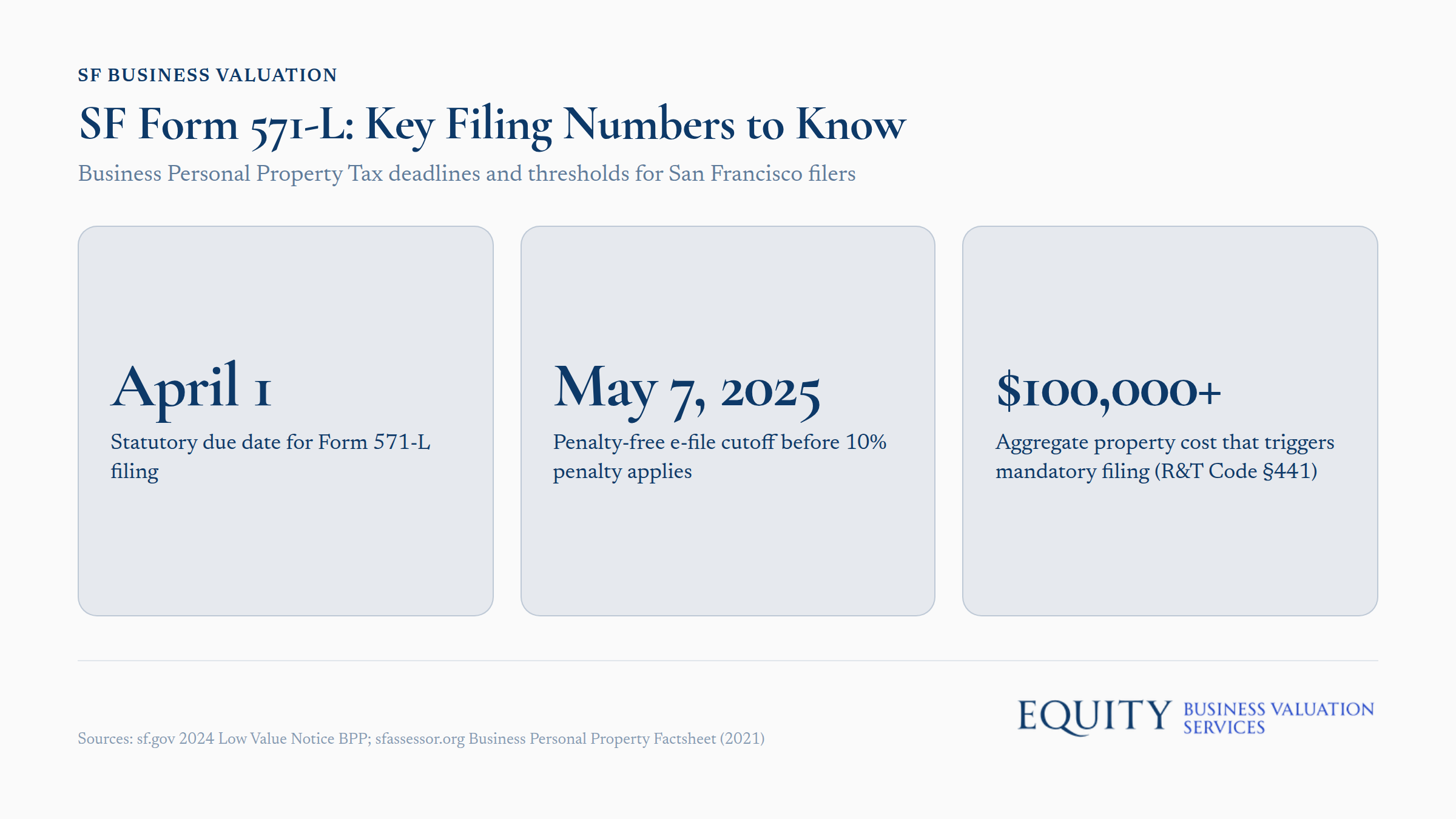
Any new business in San Francisco must file Form 571-L when it registers, and existing businesses file annually after the assessor sends a notice each spring. The statement covers the book cost of your property as of December 31 of the prior year, and the statutory due date is April 1.
Separately, San Francisco has published an e-file deadline that allows you to submit without penalty slightly later than the statutory due date. For the 2025 filing cycle, the city's low-value notice put that penalty-free e-file cutoff at May 7, 2025, after which a filing is treated as late and the 10% penalty applies to the assessed value (sf.gov).
State law also sets a mandatory filing trigger regardless of whether you receive a notice. Under Revenue and Taxation Code section 441, a business must file if it holds taxable business property with a total cost of $100,000 or more in the county, even without a request from the assessor (sfassessor.org).
Pro tip: Calendar both dates separately. The April 1 statutory deadline and the later e-file cutoff aren't the same thing, and relying on the wrong one is an easy way to end up with an avoidable penalty.
The Mandatory 10% Penalty for Late or Unfiled Statements
If you don't file Form 571-L by the applicable deadline, or you don't file at all, the assessor is required to estimate the value of your property and add a 10% penalty to that assessed value (sftreasurer.org). This penalty isn't discretionary. Revenue and Taxation Code sections 441(b) and 463 make it mandatory once the filing window has closed, and the assessor's estimate is rarely favorable to the business, since it's built without the detail a real filing would provide.
Watch out: An assessor's estimate tends to assume newer, more valuable equipment than what's actually on your floor. Businesses that skip filing because their equipment is old or heavily depreciated often end up assessed at a higher value than if they had simply reported it.
The Low-Value Exemption: Property Valued at $4,000 or Less
San Francisco exempts business personal property from taxation when its total value is $4,000 or below, under City Ordinance 308-97 (sf.gov). This threshold applies to the aggregate value of qualifying property, not a single item, so a handful of low-value assets can still fall under the exemption even if you own several of them.
This matters most for very small operations, home-based businesses, and side ventures with minimal equipment. If your total business personal property genuinely sits at or below $4,000, you may still need to file to establish that fact, but the resulting tax liability should be zero.
What Triggers an Assessor Audit or Review?
A few patterns reliably draw scrutiny from the assessor's office. The most common is simply crossing the $100,000 aggregate cost threshold that state law uses to define who must file, since the assessor tracks which businesses in that range are filing consistently and which aren't.
Beyond the dollar threshold, expect closer review when:
- Your reported costs jump or drop sharply from one year to the next without an obvious explanation, such as a location closure or major equipment purchase.
- You have a history of filing late or not filing at all, which puts your business on the assessor's follow-up list.
- Your filing appears inconsistent with your business type, for example a restaurant reporting almost no kitchen equipment.
- The assessor's office directly requests supporting documentation or schedules a physical inspection of the location.
The statewide template underlying San Francisco's local form, the Business Property Statement published by the California State Board of Equalization, gives assessors a consistent format to compare filings against (boe.ca.gov). That consistency is exactly what makes outlier filings stand out.
How the San Francisco Assessment Appeals Board Process Works
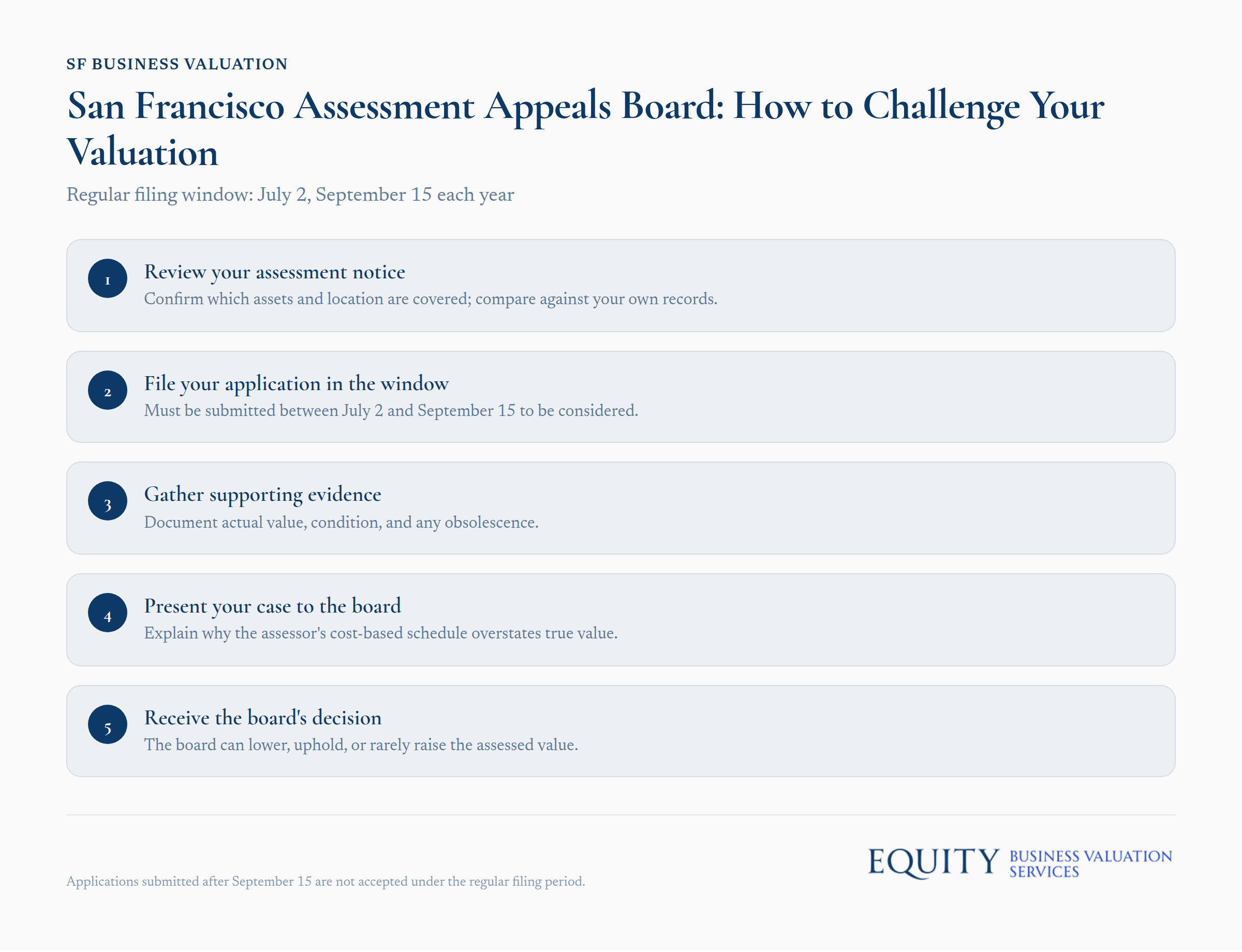
If you believe your assessed value is too high, the remedy is an appeal to the local Assessment Appeals Board, not a phone call to the assessor's office. In San Francisco, as in counties across California, the regular filing window for an assessment appeal runs from July 2 through September 15 each year.
That window is firm. Applications submitted after September 15 are not accepted under the regular filing period, so an owner who wants to challenge a valuation needs to move well before the deadline rather than after receiving the tax bill in the fall.
The general appeal sequence looks like this:
- Review your assessment notice carefully. Confirm which assets and which location the assessed value covers, and compare it against your own records of what you actually own and its condition.
- File your application within the window. The application must be submitted between July 2 and September 15 to be considered under the regular process.
- Gather supporting evidence. This is where documentation of actual value, condition, and any obsolescence becomes central to the case.
- Present your case to the board. A hearing gives you the chance to explain why the assessor's cost-based schedule overstates what the property is actually worth.
- Receive the board's decision. The board can lower, uphold, or in rare cases raise the assessed value based on the evidence presented.
How an Independent Appraisal Supports a Property Tax Appeal
The assessor's valuation method starts with your reported acquisition cost, adds sales tax, freight, and installation, and then applies a standardized valuation factor tied to the asset's expected economic life. It's a mass-appraisal approach built for efficiency across thousands of filings, and it isn't designed to capture the specific condition of your equipment.
An independent appraisal looks at the same assets from the opposite direction. Rather than starting from cost and applying a generic depreciation schedule, our appraisers inspect the actual equipment, document its condition, and analyze whether functional or economic obsolescence has reduced its value beyond what a standard percent-good table would show. A five-year-old piece of restaurant equipment that has been heavily used, is difficult to service because parts are discontinued, or has been superseded by newer, more efficient models can be worth considerably less than the assessor's schedule suggests, and a defensible report needs to explain why.
This kind of engagement covers the same categories of property that show up on Form 571-L: furniture, fixtures, machinery, and equipment. Fees are quoted as a fixed price after scoping the assignment, never billed hourly, and they scale with the number of assets, the depth of analysis required, and whether the report needs to meet a heightened standard for the appeal. As a general reference point, furniture, fixtures, and equipment (FF&E) appraisals start at $295 for a standard report and $395 for an advanced report, with typical engagements in the $695 to $2,200 range depending on the volume of assets involved and the complexity of the analysis.
For owners weighing whether the assessed fair market value on their notice actually reflects what a buyer would pay for the equipment as it sits today, understanding how fair market value is determined in other high-stakes valuation contexts is useful background. The same core principle applies here: a defensible value has to be grounded in the asset's real condition and market, not just a cost table.
Filing Accurately Beats Fighting an Estimate
The cheapest way to handle San Francisco's business personal property tax is still the simplest one: file an accurate Form 571-L on time, every year, and keep records of your acquisition costs current. When the numbers don't add up in your favor anyway, whether because equipment has aged faster than the assessor's tables assume or because the assessed value was based on an estimate after a missed filing, the Assessment Appeals Board process exists precisely for that situation, and a documented, independent valuation is what makes the appeal credible.
This article is provided for general informational purposes only and does not constitute legal, tax, or financial advice. Readers should consult a qualified attorney or CPA regarding their specific circumstances.