
Blog
How California's Probate Referee Values a Business Interest in a San Francisco Estate
A California probate referee, not the executor or the court, sets the fair market value of a decedent's business interest for the Inventory and Appraisal. Here's how that appraisal works for a San Francisco estate and what documentation actually shapes the number.
When a San Francisco business owner dies while holding stock in a corporation, membership units in an LLC, or a partnership interest, someone has to put a dollar figure on that asset for the probate court. That someone is not the executor, the family attorney, or the surviving business partner. It is a probate referee, a private appraiser appointed by the California State Controller and assigned to the case by the Superior Court. Our team prepares business valuation reports specifically built to support that process, and this guide walks through how the referee's appraisal actually works for a closely held company.
Who Appraises a Business Interest in a California Probate Estate?
The probate referee appraises every non-cash asset listed on an estate's Inventory and Appraisal, and a privately held business interest almost always falls into that category. The personal representative's job is to identify and list the assets; the referee's job, under California's probate statutes, is to independently determine what each one was worth as of the date of death.
This division of labor matters because a referee is a generalist. The same appraiser who values a decedent's business interest this week may value a coin collection, a fleet of vehicles, or a parcel of undeveloped land next week. Referees are appointed county by county and are not necessarily specialists in closely held business valuation, which is exactly why the supporting paperwork the family submits carries so much weight.
How San Francisco County Assigns a Probate Referee
When an estate is opened in San Francisco County Superior Court, the court assigns the case to the probate referee appointed for that county. The personal representative and the estate attorney do not select the referee, and they cannot shop for a more favorable one. The referee operates independently of the family and the court, working from the documentation the estate provides and their own professional judgment (filippilaw.com).
That independence is the point of the system. It also means the referee has no built-in incentive to dig deeper into a business's financials than the submitted materials require. A thin file produces a thin analysis.
What the Probate Referee Must Value on the Inventory and Appraisal
The Inventory and Appraisal is the Judicial Council form that lists every asset in the estate and its appraised value. The personal representative completes the asset descriptions; the referee signs off on the values for everything other than cash and cash-equivalent accounts, which the personal representative can value directly (riverside.courts.ca.gov).
For a business interest, that means the referee is entering a single dollar figure representing the decedent's ownership stake as of the date of death. That figure becomes the basis for calculating the referee's own fee, informing any eventual estate tax exposure, and setting the number heirs will later compare against a buyout offer or a sale price. Getting it wrong in either direction creates real downstream problems for the estate.
What Documentation a Closely Held Business Needs for the Referee
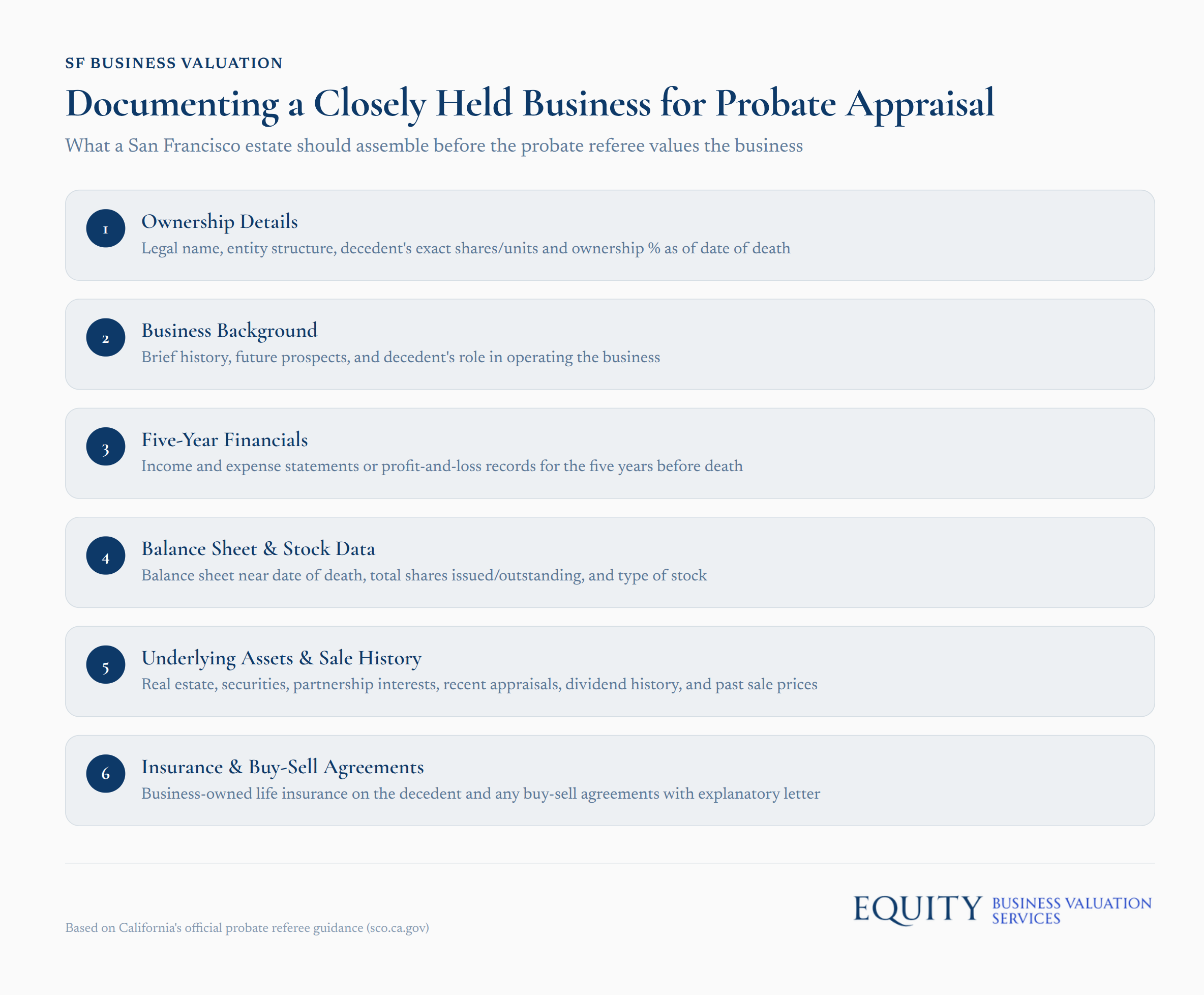
California's official probate referee guidance lists the materials a personal representative should assemble for a business interest before the referee can complete a defensible appraisal (sco.ca.gov). A well-organized file typically includes:
- The entity's legal name, structure, and the decedent's exact number of shares or units and ownership percentage as of the date of death.
- A brief history of the business, its future prospects, and the decedent's role in operating it.
- Income and expense statements or profit-and-loss records for the five years preceding death.
- A balance sheet prepared at or near the date of death, along with the total shares issued and outstanding and the type of stock involved.
- A description of the underlying assets on the balance sheet, including real estate, securities, and any partnership interests, plus copies of any appraisals of those underlying assets completed within the past five years.
- Dividend history, if applicable, and a record of any prior sales of stock or partnership interests, including the number of shares or units sold, the date, and the price.
- Information on any business-owned life insurance covering the decedent, along with any buy-sell agreements and a letter explaining how they apply.
A referee working from a complete version of this file has something to actually analyze. A referee working from a name and a guess does not.
How Much Does a Probate Referee Charge to Appraise a Business?
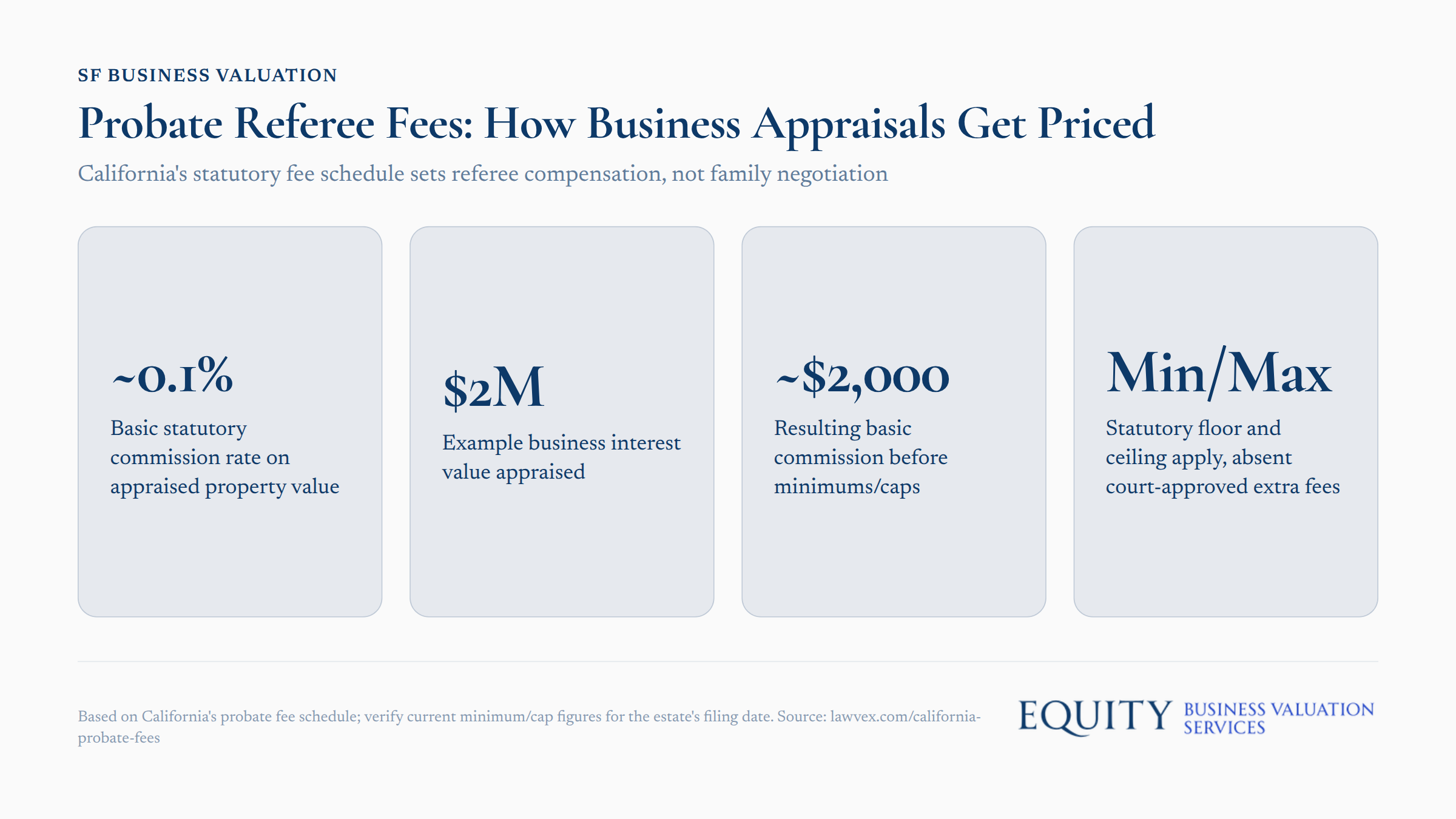
Referee compensation is set by California's probate fee schedule, not negotiated with the family. The statute establishes the referee's commission as a small percentage of the value of the property appraised, subject to a statutory minimum and a cap absent court authorization for extraordinary services (lawvex.com).
Example: A business interest appraised at $2 million produces a basic statutory commission in the range of roughly $2,000, before any minimum, maximum, or court-approved extraordinary compensation is applied. The exact figures should always be checked against the fee schedule in effect for the estate's filing date, since the minimum and cap are subject to periodic adjustment.
Why a Professional Business Valuation Report Matters to the Referee's Conclusion
Because the probate referee is a generalist appraiser covering every category of estate property, the strength of the value entered on the Inventory and Appraisal often depends on what the family submits alongside the required checklist. An independent business valuation report, prepared using recognized methodology under the income, market, and asset approaches, gives the referee a defensible foundation rather than a bare set of financial statements to interpret alone.
Watch out: A referee working only from raw tax returns or an outdated balance sheet has to make judgment calls about earnings normalization, marketability discounts, and goodwill with no analytical support. Those judgment calls can push the appraised value in either direction, and the family has no say once the Inventory and Appraisal is filed.
Our appraisers hold credentials with organizations such as the ASA and NACVA, and every report we prepare for a probate matter is built in accordance with USPAP and The Appraisal Foundation's standards. For a probate engagement, our business valuation service is quoted as a fixed fee after scoping the assignment: standard reports start at $4,500, IRS-qualified reports start at $5,500, and most closely held business matters fall between $7,500 and $12,000 depending on the entity's complexity and the completeness of its financial records. This is the same category of engagement covered in more depth in our guide to IRS-qualified business valuation for San Francisco estates, since many probate files eventually feed into an estate tax filing as well.
Pro tip: Commission the valuation report before the referee is assigned, not after a low value has already been entered on the Inventory and Appraisal. Correcting a filed appraisal is far more difficult than supporting a strong one from the start.
When Is the Inventory and Appraisal Due in a San Francisco Estate?
California probate procedure generally requires the personal representative to file the Inventory and Appraisal within a set window after letters are issued, commonly cited as four months. That timeline leaves limited room to assemble five years of financial statements, a balance sheet, and a valuation report from scratch, which is why estates with a business interest benefit from starting the documentation process as soon as probate is opened rather than waiting for the referee's assignment.
A business interest rarely sits alone in a San Francisco estate. It usually shares the Inventory and Appraisal with real property, investment accounts, and personal property, all of which the referee must also value within the same filing window. Building the business file early keeps the whole inventory on schedule.
If your family is navigating a San Francisco probate that includes a closely held business, request a business valuation built specifically for the referee's use, and give the estate a defensible number from the start rather than a contested one later.
This article is provided for general informational purposes only and does not constitute legal, tax, or financial advice. Readers should consult a qualified attorney or CPA regarding their specific circumstances.