
Blog
How Appraisers Value a San Francisco Tech Startup With Recurring Revenue but No Profit
Valuing a startup with no profit means setting aside the income approach and leaning on ARR multiples, burn rate analysis, and net asset value instead. Here's how a business appraiser builds a defensible number for a cash-burning San Francisco SaaS company.
San Francisco's tech economy runs on a business model that breaks traditional valuation math: recurring revenue, fast growth, and often no profit at all. A SaaS company can have $3 million in annual recurring revenue, a loyal customer base, and a negative bottom line, and still be worth eight figures. Valuing a startup with no profit requires a different toolkit than valuing a profitable local business, and getting the approach wrong produces a number no lender, investor, or court will trust.
Our business valuation team works with early and growth-stage tech companies across the Bay Area on exactly this problem: how do you put a defensible number on a business that is, by design, spending more than it earns?
Why the Income Approach Falls Short for Pre-Profit SaaS Companies
The income approach estimates value from a company's ability to generate cash flow or earnings, capitalized or discounted back to a present value. That approach depends on a positive, sustainable stream of discretionary earnings or free cash flow. A startup that is intentionally burning cash to fund customer acquisition and product development simply does not have that input.
This is not a flaw in the company. Reinvesting revenue into growth rather than showing profit is a deliberate strategy for most venture-backed SaaS businesses, and it is common enough in San Francisco's tech sector that appraisers expect it. But an income approach applied on its own to negative or near-zero earnings either understates the business badly or produces a value that swings wildly based on when the company decides to flip the profitability switch.
An appraiser can still build a discounted cash flow model that projects a future path to profitability, and that model has real value as a supporting exhibit. On its own, though, it is speculative for a company with no operating history at breakeven. That is why the market approach, built around recurring revenue multiples, typically carries the primary weight in these engagements.
How ARR Multiples Work as a Market-Approach Substitute
For a company with recurring revenue and no profit, the market approach usually starts with annual recurring revenue (ARR) rather than earnings, applying a multiple drawn from comparable private transactions and public SaaS benchmarks. The formula is simple in concept: enterprise value equals ARR times a multiple, with the multiple doing most of the analytical work.
That multiple is not a flat industry number. General industry data on private SaaS transactions places typical revenue multiples for growth-stage companies in roughly the low-single-digit range, with the strongest-performing businesses (high growth, strong retention, healthy margins) commanding multiples well above the median and slower-growth or high-churn businesses compressing toward the low end. The factors that move a company up or down that range include:
- Growth rate: Companies growing 30% to 50% or more annually typically support meaningfully higher multiples than those growing in the single digits.
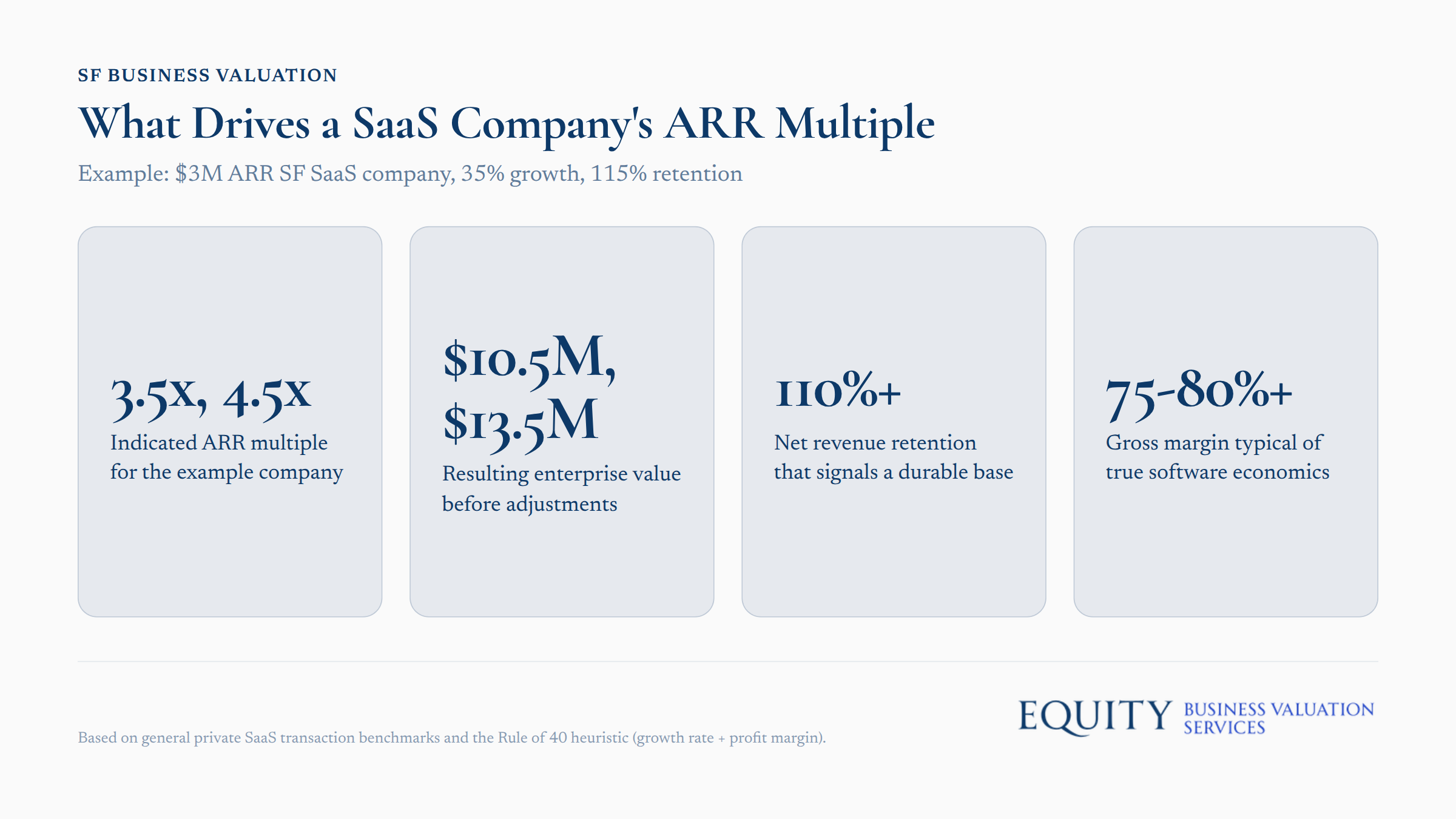
- Net revenue retention (NRR): Retention above 110%, meaning existing customers are spending more over time even before new sales, signals a durable revenue base and supports a premium multiple.
- Gross margin: True software margins above roughly 75% to 80% support a higher multiple than businesses with heavy services or hosting costs baked into cost of revenue.
- The Rule of 40: A widely used industry heuristic that adds growth rate and profit margin together; scoring near or above 40 signals a healthy balance between growth and burn, even when the margin component is negative.
- Customer concentration and churn: A revenue base spread across many customers with low churn is worth more per dollar of ARR than the same revenue concentrated in a handful of accounts.
Example: A San Francisco SaaS company with $3 million in ARR, 35% year-over-year growth, and 115% net revenue retention might reasonably support a multiple in the 3.5x to 4.5x range, indicating an enterprise value in the $10.5 million to $13.5 million band before any adjustments for cash, debt, or company-specific risk. A comparable business with the same $3 million in ARR but 12% growth and 90% retention would land at a materially lower multiple and a lower indicated value, even though the top-line revenue is identical.
Burn Rate and Runway: Sanity-Checking the Revenue Multiple
A revenue multiple only tells part of the story, so appraisers pair it with a burn rate and runway analysis to test whether the indicated value holds up. Burn rate is the pace at which the company is spending cash net of revenue each month, and runway is the number of months of operating cash remaining at that pace.
Example: A company with $1.8 million in the bank and a net monthly burn of $200,000 has roughly 9 months of runway. That is a materially different risk profile than a company with 24 months of runway at the same burn rate, even if both companies show identical ARR and growth figures on paper.
Short runway raises the likelihood that the company will need to raise capital soon, on terms it may not control, which introduces dilution risk and downward pressure on a per-share or enterprise value conclusion. Appraisers use runway analysis to decide where within a supportable multiple range a given company should land, and whether a downward adjustment is warranted for financing risk that the revenue multiple alone does not capture. A company burning cash responsibly toward a clear path to profitability supports a higher multiple than one burning cash with no visible plan to slow the loss rate.
Watch out: A high ARR growth rate paired with an unsustainably short runway is not automatically a red flag for the multiple selection, but it does require an explicit discussion in the report of how financing risk was weighed. Skipping that step is one of the more common gaps in valuations prepared without appraisal training.
The Asset-Based Approach as a Valuation Floor
The asset-based approach rarely drives the final conclusion for a growing SaaS company, but it plays an important role as a floor. This approach totals the company's tangible and identifiable intangible assets, cash, receivables, capitalized software development, equipment, and intellectual property, and subtracts liabilities to arrive at a net asset value.
In its most conservative form, an appraiser may also consider an orderly liquidation or net salvage premise: what the company's assets would fetch if operations wound down in an orderly manner rather than a fire sale. That figure typically sits well below the going-concern value indicated by the ARR multiple for a healthy, growing business, but it matters for two reasons. It establishes a defensible lower bound that a market-approach conclusion should never fall below, and it becomes the primary approach of record if the company's growth story falls apart entirely and no willing buyer would pay a premium for the revenue stream.
Reconciling the Approaches for a San Francisco Startup
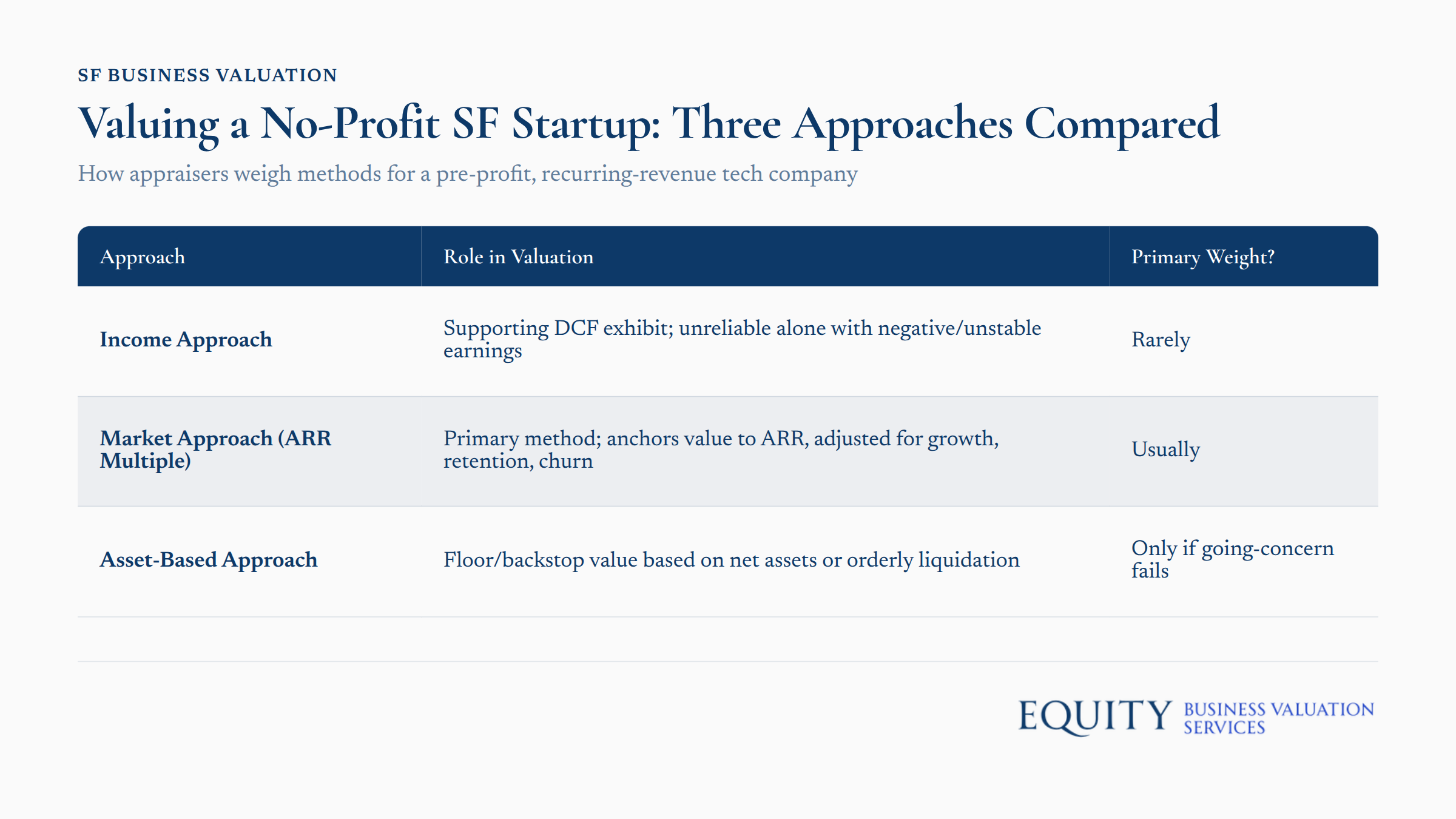
A credible valuation for a pre-profit, recurring-revenue company weighs each approach according to what it can actually tell you, rather than averaging them mechanically.
| Approach | Role in a No-Profit SaaS Valuation | Primary Weight? |
|---|---|---|
| Income approach | Supporting exhibit via a DCF modeling a path to profitability; unreliable alone with negative or unstable earnings | Rarely |
| Market approach (ARR multiple) | Primary method; anchors value to recurring revenue and adjusts for growth, retention, margin, and churn | Usually |
| Asset-based approach | Floor or backstop value based on net assets or orderly liquidation | Only if going-concern assumptions fail |
USPAP-Compliant Reporting and Fixed-Fee Engagements
Whatever the purpose, whether it is a funding round, a shareholder dispute, an estate matter, or a divorce proceeding involving a founder's equity, the report needs to hold up to scrutiny. Our appraisers prepare business valuations in accordance with USPAP (Uniform Standards of Professional Appraisal Practice), published by The Appraisal Foundation, and reference the methodology standards recognized by credentialing bodies such as the ASA and NACVA.
For readers weighing which financial metric to lean on when a company is not yet using GAAP earnings as its headline number, our guide on SDE versus EBITDA in business valuation covers how those metrics apply once a company does turn a profit, and why neither one is the right starting point for a pre-profit SaaS business.
Engagements are quoted as a fixed fee scoped before work begins, based on the complexity of the assignment, the number of entities or classes of equity involved, and whether the report needs to be IRS-qualified, never on the concluded value of the company. Our published business valuation fees start at $4,500 for a standard engagement and $5,500 for an IRS-qualified report, with typical engagements running $7,500 to $12,000 and the most complex assignments, including multi-entity structures or contested valuations, reaching $15,000 to $20,000 or more.
Getting a Defensible Number Before You Need One
A pre-profit tech company is not unvaluable, it is just valued differently. The ARR multiple carries most of the weight, burn rate and runway analysis keep that multiple honest, and the asset-based approach sits underneath as a floor. Waiting until a dispute, a tax filing deadline, or a financing term sheet forces the question is the wrong time to start building that analysis from scratch. If your San Francisco company has recurring revenue but hasn't turned a profit, request a business valuation from our team and get a scoped, fixed-fee quote before the engagement begins.
This article is provided for general informational purposes only and does not constitute legal, tax, or financial advice. Readers should consult a qualified attorney or CPA regarding their specific circumstances.