
Blog
SDE vs EBITDA in Business Valuation: Which Metric Fits Your San Francisco Company?
SDE and EBITDA measure a business's earnings differently, and using the wrong one in a valuation can shift the concluded value by tens of thousands of dollars. This guide explains which measure fits owner-operated San Francisco businesses versus professionally managed ones, and why the choice changes the multiple a buyer will pay.
San Francisco's small business economy runs the full range from a single-owner coffee roaster in the Mission to a SoMa software company with a dozen employees and a management team. Both need a defensible earnings figure before anyone can talk about value, but they don't use the same one. Seller's Discretionary Earnings (SDE) and EBITDA are the two measures that drive most small and mid-sized business valuations, and picking the wrong one can distort a sale price before negotiations even start.
This matters well beyond the spreadsheet. Buyers, lenders, and courts all rely on the earnings measure to anchor a value, and our business valuation services exist precisely to get that starting point right. If you're trying to understand how a small business gets valued in the first place, SDE and EBITDA are the two building blocks behind almost every method you'll encounter.
What Is SDE and What Is EBITDA?
SDE is the total pre-tax economic benefit available to one full-time owner-operator. EBITDA is the cash flow a business generates before financing, tax, and non-cash accounting charges, assuming it runs under paid, arms-length management.
The formulas share a foundation but diverge in one critical place. EBITDA starts with net profit and adds back interest, taxes, depreciation, and amortization, as BDC's glossary of financial terms describes it. It stops there. A manager's salary, even the owner's, stays in the expense line because EBITDA assumes someone has to be paid to run the place.
SDE takes EBITDA's starting point and goes further. It adds back the owner's full salary, payroll taxes, and benefits, along with documented personal or one-time expenses that a buyer stepping into the owner's chair wouldn't need to keep paying: a personal vehicle, unusual travel, a one-off legal settlement. The idea is simple: SDE answers the question "what would this business hand its next owner-operator in a full year of work and pay?"
The Core Difference: Who Runs the Business After the Sale
Every difference between the two measures traces back to one assumption: will the buyer work in the business, or hire someone to run it?
A Mission District coffee roaster with one owner behind the counter and two part-time baristas assumes the next buyer will do the same job the current owner does. SDE captures that reality by folding the owner's paycheck back into earnings, because that paycheck is really part of what the business is worth to a hands-on buyer.
A SoMa-based SaaS company with a small operations team, a sales manager, and a founder who no longer touches day-to-day delivery is a different animal. Its earnings already reflect what it costs to keep management in place. Adding back a founder's salary would overstate what a new, passive owner could actually expect to pocket, so EBITDA leaves that cost where it belongs, in the expense column.
SDE vs EBITDA at a Glance
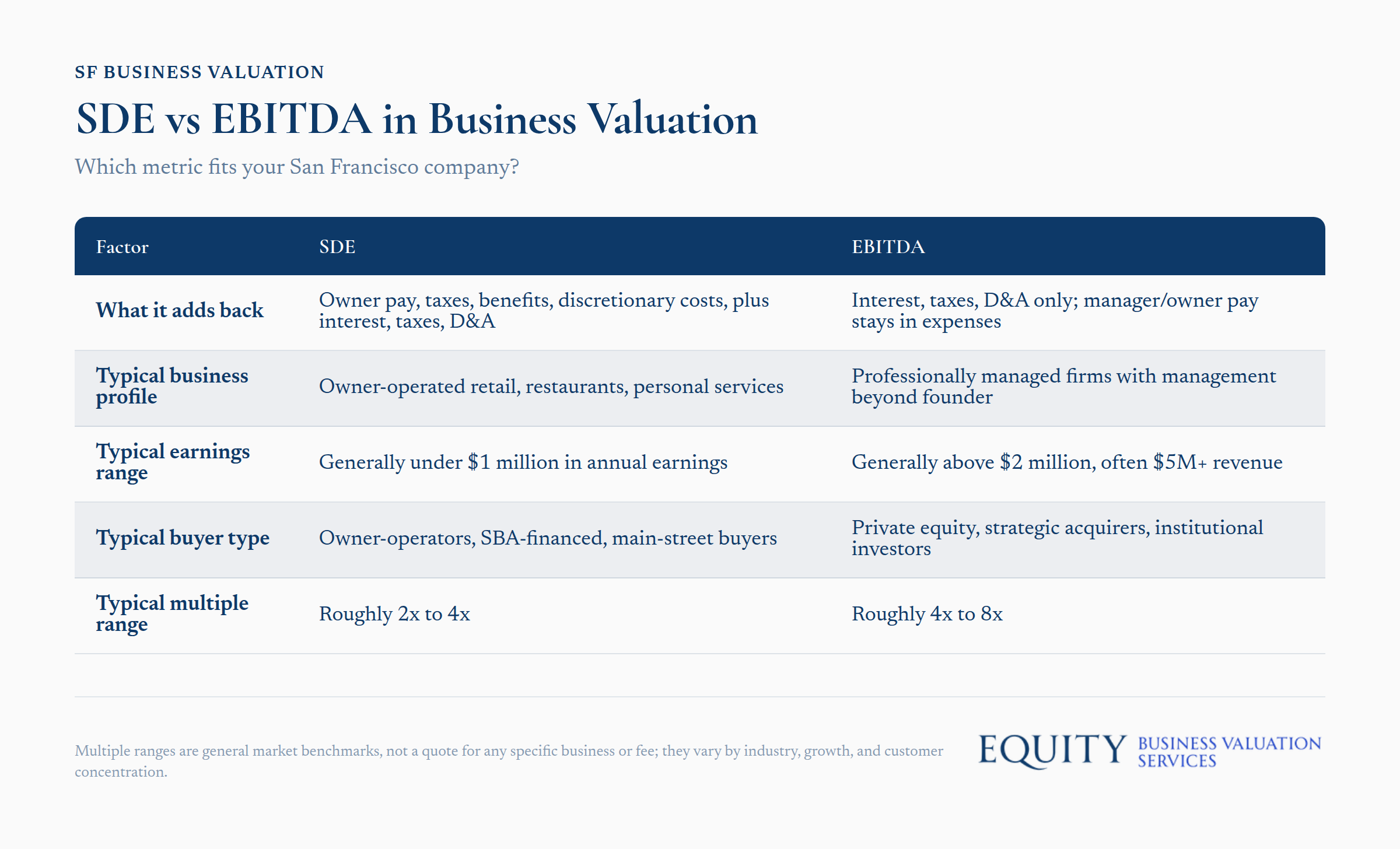
The table below summarizes how the two measures diverge across the factors that matter most in a sale: what gets added back, who typically uses each figure, and the multiple ranges the market applies to each.
| Factor | SDE | EBITDA |
|---|---|---|
| What it adds back | Owner salary, payroll taxes, benefits, personal or discretionary expenses, plus interest, taxes, depreciation, amortization | Interest, taxes, depreciation, amortization only; manager and owner pay stays in expenses |
| Typical business profile | Owner-operated retail, restaurants, personal services | Professionally managed companies with a management layer beyond the founder |
| Typical earnings range | Generally under $1 million in annual earnings | Generally above $2 million in earnings, often paired with $5 million or more in revenue and management depth |
| Typical buyer type | Owner-operators, SBA-financed buyers, main-street buyers | Private equity, strategic acquirers, institutional investors |
| Typical multiple range | Commonly cited in the roughly 2x to 4x range | Commonly cited in the roughly 4x to 8x range |
Those multiple ranges are general market benchmarks, not a quote for any specific business or for our own fees. They vary by industry, growth trajectory, customer concentration, and dozens of other factors specific to the company being valued.
Which Earnings Measure Fits Your Business?
Most businesses under roughly $1 million in annual earnings are valued on SDE, because a single owner-operator is still doing most of the work that keeps the doors open. Once earnings cross into the $1 million to $2 million range, the market treats that as a transition zone: some buyers will still want SDE, others will start asking for an EBITDA view, especially if the business already has a manager or two on payroll.
Above roughly $2 million in earnings, and particularly when the business is also clearing around $5 million in revenue with real management depth, EBITDA becomes the standard measure. At that size, buyers assume they're acquiring a system that runs without the founder standing behind the counter, and they want an earnings figure that reflects that reality.
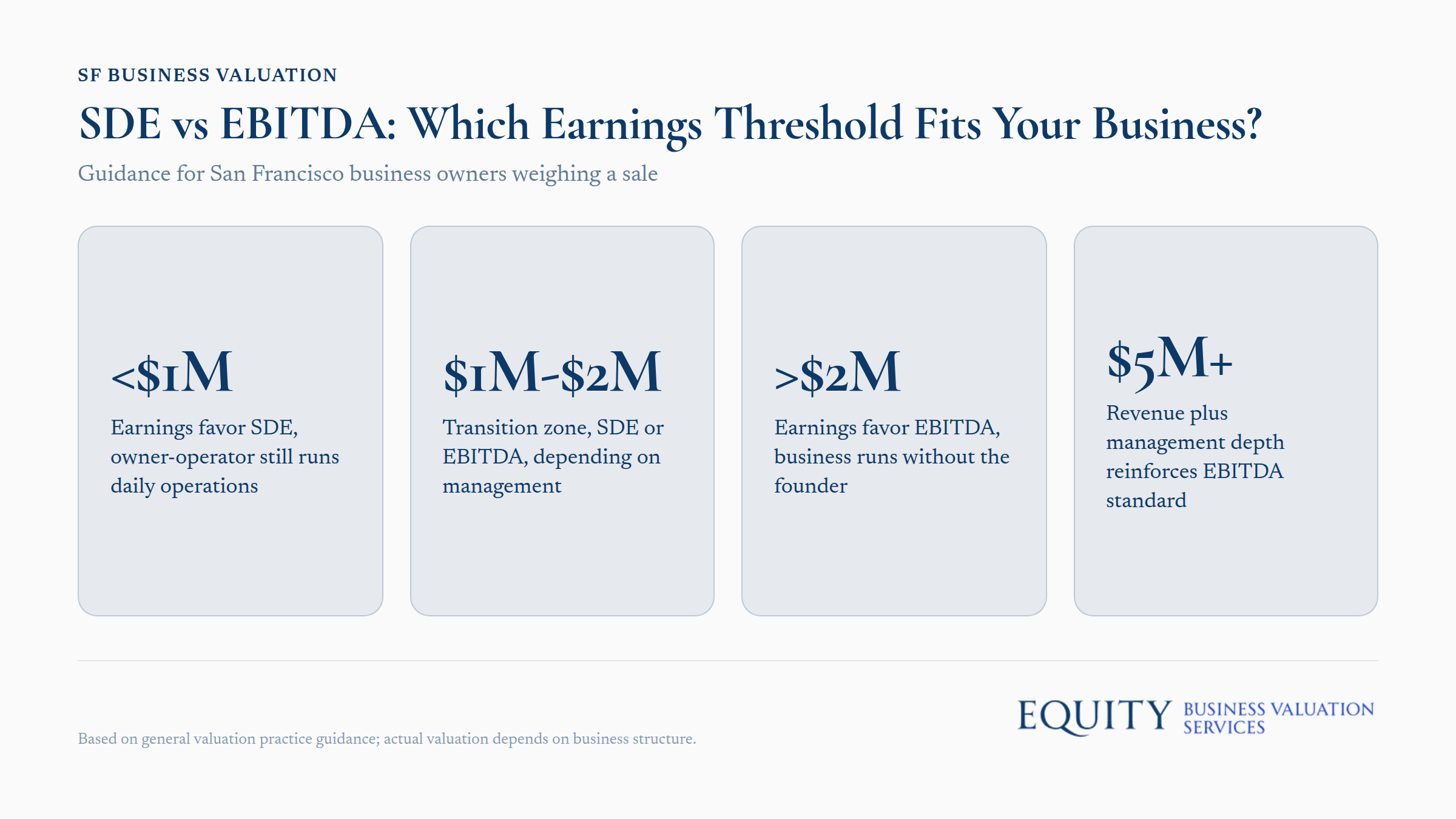
A San Francisco owner considering a sale can use these thresholds as a first gut check, but the actual valuation still has to account for the specific structure of the business. A restaurant with $900,000 in revenue and a hands-on owner-chef is almost certainly an SDE story. A logistics software company with $6 million in revenue and a hired CEO is almost certainly an EBITDA story. Plenty of San Francisco businesses land somewhere in between, and that's exactly where a professional valuation earns its keep.
Why Multiples Differ Between SDE and EBITDA
SDE multiples run lower than EBITDA multiples because SDE is the larger number. Once you've added back a full owner salary and a set of perks, the resulting earnings figure is bigger than EBITDA for the same business, so a smaller multiple gets you to a similar order of magnitude in value. Applying an EBITDA-style multiple to an SDE figure, or vice versa, produces a distorted number almost immediately.
Buyer-side financing plays into this too. SBA-backed buyers, who dominate the market for owner-operated San Francisco businesses, underwrite deals around the owner's cash flow, which is why SDE remains the standard reference point for loans in that range. Larger deals financed with a mix of equity and leveraged debt are structured around EBITDA because that's the cash flow lenders and investors use to size debt capacity.
Watch out: Mixing up the two measures during a negotiation is one of the fastest ways to blow up a deal. A seller who quotes an EBITDA-based multiple against an SDE-based earnings figure (or the reverse) is effectively asking the buyer to pay for owner compensation twice, once in the earnings number and again in the multiple.
Example: A Mission District coffee roaster generates $100,000 in pre-tax net income after paying its owner an $80,000 salary and $15,000 in personal expenses run through the business, plus $5,000 in interest and $10,000 in depreciation. SDE comes to $210,000 ($100,000 + $5,000 + $10,000 + $80,000 + $15,000). At a market-appropriate 3x SDE multiple, the business values at roughly $630,000. If a buyer mistakenly applied a 5x EBITDA-style multiple to that same $210,000 figure instead, the calculated value would jump to $1,050,000, an overstatement of $420,000 built entirely on using the wrong multiple for the wrong earnings measure.
Getting the Measure Right Before You Negotiate
Choosing between SDE and EBITDA isn't a formality. It determines which buyers will even look at the deal, what multiple range applies, and how a lender underwrites financing. A business appraisal that misapplies one measure for the other doesn't just produce an odd number; it can cost a seller real money at the negotiating table or expose a buyer to overpaying.
Organizations that maintain private transaction databases, including the National Association of Certified Valuators and Analysts (NACVA) through resources like the BIZCOMPS database, report actual sale multiples tied to SDE for smaller, owner-operated transactions, which is one reason credentialed valuation analysts lean on documented market data rather than rules of thumb alone. Professional valuation standards call for analysts to select the earnings measure that actually matches how the specific business would transact, not the one that's easiest to calculate.
If you're weighing a sale, a partnership buyout, or simply want to know where your business sits before you go to market, our team can walk through your financials, identify whether SDE or EBITDA better reflects your situation, and prepare a valuation built on the standard your buyer or lender will actually expect.
This article is provided for general informational purposes only and does not constitute legal, tax, or financial advice. Readers should consult a qualified attorney or CPA regarding their specific circumstances.