
Blog
Normalizing Owner Salary and Add-Backs Before You Sell Your San Francisco Business
Normalizing owner salary in a business valuation means replacing reported compensation with its true market cost, not simply adding back every dollar the owner was paid. This guide walks San Francisco owners through the three standard add-back categories, the documentation each one requires, and a worked example showing how SDE and normalized EBITDA treat the same owner paycheck differently.
Buyers do not pay for what your tax return says you earned. They pay for what the business will earn once someone else is running it, which is exactly why normalizing owner salary sits at the center of almost every pre-sale valuation dispute we see in San Francisco. Get the add-backs right and you have a defensible number a buyer's lender will accept. Get them wrong, inflate the owner comp add-back, double-count a benefit, or skip the documentation, and the first thing a buyer's accountant does is strip your number back down.
This guide builds on our SDE vs EBITDA business valuation guide and goes one layer deeper: how to normalize the owner's paycheck itself, which add-backs are defensible, and what records support each one.
What Normalizing Owner Compensation Actually Means
Normalizing owner compensation means adjusting the business's reported earnings to reflect the market cost of replacing the owner's actual work, not automatically adding back every dollar the owner was paid. The adjustment you make depends entirely on which earnings metric you're building: Seller's Discretionary Earnings (SDE) or normalized EBITDA.
A business with one working owner who draws a salary, benefits, and a mix of personal expenses through the company will look very different once normalized than its raw tax return suggests. The goal is not to maximize the add-back. The goal is to show a buyer, and that buyer's lender, exactly what changes and what doesn't once the owner walks out the door.
SDE vs Normalized EBITDA: Two Different Rules for the Same Paycheck
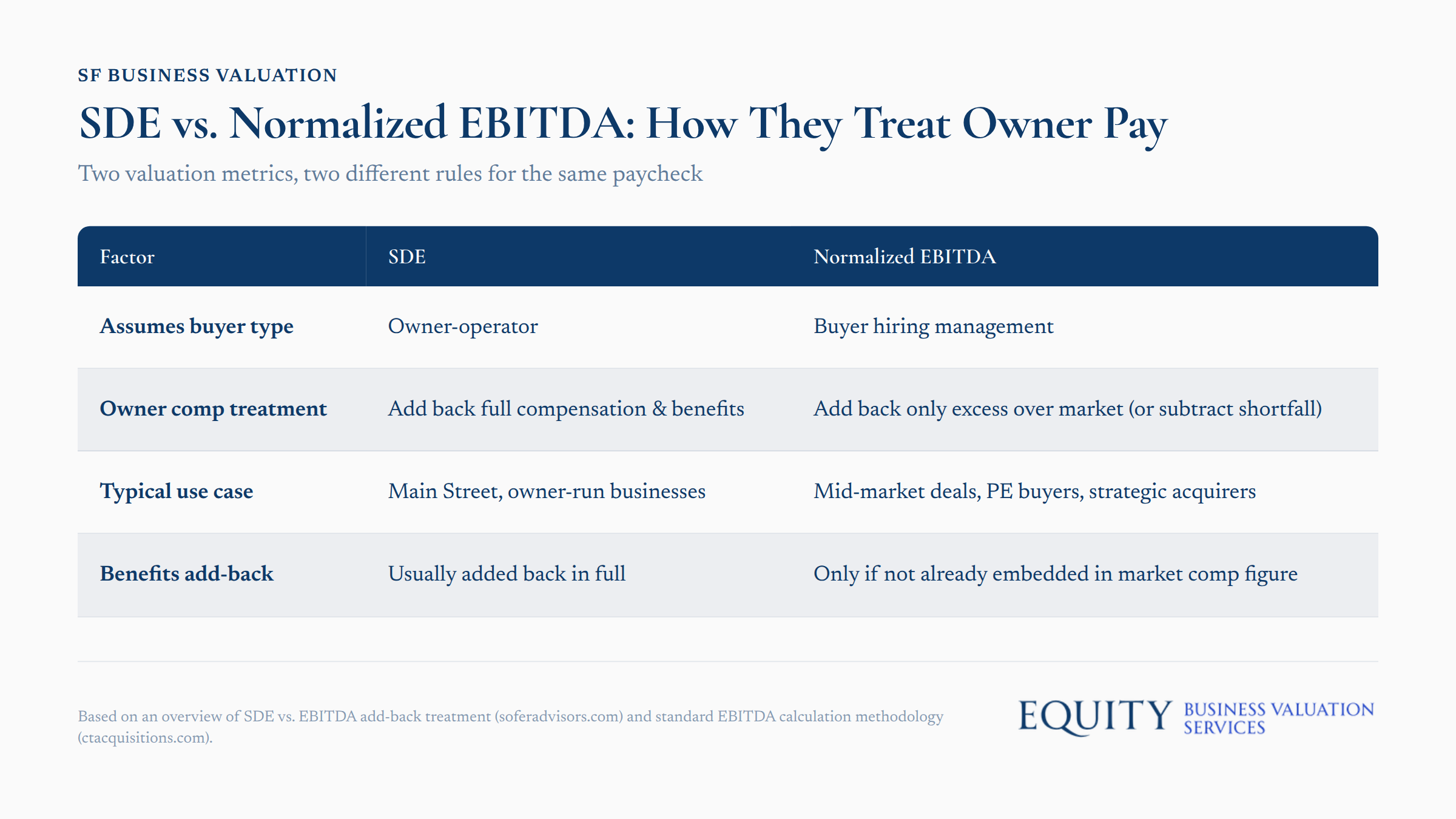
SDE and normalized EBITDA treat owner compensation differently, and conflating the two is the single most common mistake we see in owner-prepared valuations. SDE assumes a single owner-operator buyer and adds back that owner's full compensation and benefits. Normalized EBITDA assumes a buyer who will employ a manager, so it only adjusts for the gap between what the owner was actually paid and what a market-rate replacement would cost.
Under SDE, the calculation commonly starts with pretax income and adds back one working owner's compensation and benefits, interest, depreciation and amortization, and documented nonrecurring expenses, representing the full economic benefit available to a single owner-operator. Under normalized EBITDA, owner compensation is generally not fully added back. Instead, the adjustment is limited to the difference between what the owner was actually paid and the market compensation required for the role: if the owner was paid above market, you add back the excess; if the owner was paid below market or took no salary, you subtract the replacement cost instead.
| SDE | Normalized EBITDA | |
|---|---|---|
| Assumes buyer type | Owner-operator | Buyer hiring management |
| Owner comp treatment | Add back full compensation and benefits | Add back only the excess over market rate (or subtract shortfall) |
| Typical use case | Main Street, owner-run businesses | Mid-market deals, PE buyers, strategic acquirers |
| Benefits add-back | Usually added back in full | Only if not already embedded in market comp figure |
A defensible add-back under either metric still needs a clear connection to the seller or a nonrecurring event, evidence the expense won't continue after closing, and supporting records that tie back to the general ledger, as described in an overview of how SDE and EBITDA treat add-backs differently. The buyer's side of the table does its own version of this math using standard EBITDA calculation methodology, so your add-back schedule should be built to survive that scrutiny, not just to look good on your own spreadsheet.
The Three Standard Add-Back Categories
Most legitimate add-backs fall into one of three buckets: owner compensation, discretionary or personal expenses, and one-time or nonrecurring costs. Each category has its own logic and its own documentation standard, and mixing them up is where valuations lose credibility.
Owner Compensation
Owner compensation add-backs are only as strong as the comparable salary data behind them. If you're building SDE, you add back the owner's full W-2 wages and related payroll costs. If you're building normalized EBITDA, you need a role-specific compensation benchmark for the actual duties, hours, geography, and required qualifications, because the add-back is the gap between actual pay and that benchmark, not the whole paycheck.
Federal tax rules don't supply a fixed dollar figure for reasonable compensation. The IRS instead applies a facts-and-circumstances test that weighs training and experience, duties and responsibilities, time and effort, pay to non-owner employees doing comparable work, and comparable market compensation, a standard the IRS outlines in its guidance on S-corporation compensation. That same facts-and-circumstances lens, drawn from the valuation standards that trace back to Revenue Ruling 59-60, is what a credentialed appraiser applies when deciding how much of an owner's pay is replaceable versus how much reflects genuine market-rate work.
Discretionary and Personal Expenses
Personal expenses run through the business only qualify as add-backs when they're separable, documented, and genuinely discretionary. A personal vehicle lease, a spouse's health insurance premium, or a country club membership can all be legitimate add-backs, but only with records showing the expense is personal in nature and would disappear under new ownership.
Watch out: A buyer will not accept an add-back just because the expense benefited the seller personally. The real test is whether the cost would vanish for a hypothetical new owner and whether your records actually prove it.
One-Time and Nonrecurring Expenses
One-time costs, a lawsuit settlement, a flood repair, a lease buyout, a relocation, belong in the add-back schedule only when they're genuinely isolated to a single period. A recurring expense doesn't become nonrecurring just because the seller labels it that way, and an expense the buyer will keep paying (required management salary, standard rent, ongoing software or compliance costs) is not a legitimate add-back at all.
Documentation Checklist by Category
Every add-back needs a paper trail that matches its category. Build your file before a buyer asks for it, not after:
- Owner compensation: payroll records and W-2s for the period under review, a written job description, hours worked, and a market compensation survey or comparable job posting for the role.
- Discretionary and personal expenses: general ledger entries tagged to the specific line item, original receipts or invoices, mileage logs for vehicle use, and insurance statements separating owner-only coverage from staff benefits.
- One-time and nonrecurring expenses: vendor invoices, insurance claim documentation, signed lease termination or settlement agreements, and prior-year tax returns showing the expense didn't recur.
Our guide to how we value what a small business is worth walks through how this documentation feeds the broader valuation, beyond just the add-back schedule.
Worked Example: Add-Back Schedule for a San Francisco Cafe
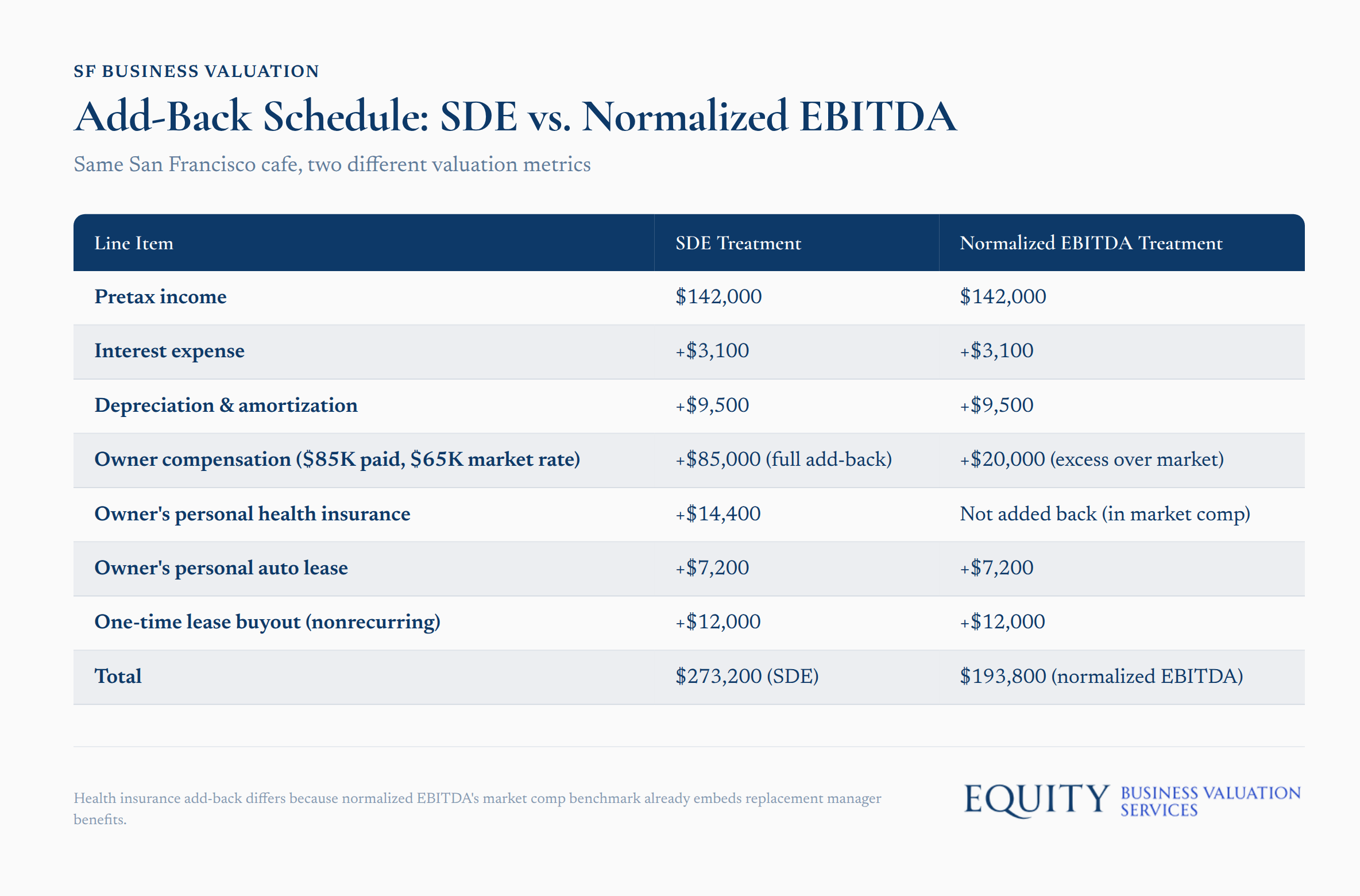
A single-location San Francisco cafe reports $142,000 in pretax income. The owner works full-time in the business, draws an $85,000 salary, and runs several personal expenses through the company. Here's how the same facts produce two different numbers depending on the metric.
| Line Item | SDE Treatment | Normalized EBITDA Treatment |
|---|---|---|
| Pretax income | $142,000 | $142,000 |
| Interest expense | +$3,100 | +$3,100 |
| Depreciation & amortization | +$9,500 | +$9,500 |
| Owner compensation ($85,000 paid; $65,000 market rate for a working manager) | +$85,000 (full add-back) | +$20,000 (excess over market only) |
| Owner's personal health insurance | +$14,400 | Not added back (embedded in market comp estimate) |
| Owner's personal auto lease | +$7,200 | +$7,200 |
| One-time lease buyout (documented, nonrecurring) | +$12,000 | +$12,000 |
| Total | $273,200 (SDE) | $193,800 (normalized EBITDA) |
Example: Notice the health insurance line. Under SDE, where the owner's entire compensation package is replaced, the full insurance premium gets added back alongside the salary. Under normalized EBITDA, the $65,000 market compensation benchmark already assumes a replacement manager receives a comparable benefits package, so adding the insurance back a second time would double-count it. That single line item is the difference between a $273,200 figure and a $193,800 figure for the exact same business.
Avoiding Double-Counting Add-Backs
Key takeaway: The fastest way to lose credibility with a buyer is to add back an expense twice under two different labels. If you add back the owner's full compensation under SDE, you cannot also separately add back benefits, bonuses, or perks that were part of that same compensation package; they're already inside the number. The same logic applies to depreciation embedded in equipment lease payments, or interest embedded in a loan payment that's also being added back as a standalone line.
Before finalizing any add-back schedule, trace every adjustment back to a single line in the general ledger and confirm it hasn't already been captured somewhere else in the schedule.
Why Reasonableness Standards Matter in a San Francisco Sale
If your sale involves SBA financing, the lender's valuation engagement follows requirements set out in SBA SOP guidance, but that guidance does not hand you a compensation formula. The judgment call on how much of an owner's pay is a legitimate add-back still rests with the appraiser, using the same reasonableness factors that apply elsewhere in income tax law.
Those same factors shape how payroll and reported wages get treated for employer tax purposes, as laid out in the IRS's guidance for employers on withholding and reporting, and how fringe benefits like health coverage are classified, covered in the IRS's guide to taxable and nontaxable fringe benefits. Neither document sets a salary number for your specific business, but both inform the kind of documentation a careful appraiser expects to see before accepting a compensation add-back.
It's also worth remembering that a business sale itself gets taxed asset by asset. The IRS's guidance on the sale of a business explains that a lump-sum sale is treated as a sale of individual assets, allocated using the residual method across goodwill, equipment, inventory, and other categories. That allocation doesn't change your normalized earnings figure, but it's the next conversation your buyer's accountant will have right after reviewing your add-back schedule.
Getting Your Add-Back Schedule Ready for a Sale
A clean normalization schedule, built on the right metric for your buyer pool and backed by payroll records, invoices, and comparable salary data, is one of the clearest signals to a buyer that your asking price is grounded in reality rather than optimism. Owners who wait until diligence to build this file almost always end up negotiating from a weaker position than owners who build it first.
Our business valuation engagements are quoted as a fixed fee once we've scoped your business and its record-keeping, never billed hourly, and every report is prepared with the documentation standard a buyer's lender will expect to see. If you're planning a sale and want your owner compensation and add-back schedule built correctly the first time, request a business valuation and we'll walk you through exactly what your books support.
This article is provided for general informational purposes only and does not constitute legal, tax, or financial advice. Readers should consult a qualified attorney or CPA regarding their specific circumstances.