
Blog
How to Appeal a Business Personal Property Tax Assessment in San Francisco
Appealing a business personal property tax assessment in San Francisco means filing with the Assessment Appeals Board, not the Assessor, and only during the July 2 to September 15 window. This guide covers the deadlines, documentation, and independent valuation evidence that give an appeal its best chance.
Every year, San Francisco's Office of the Assessor-Recorder puts a dollar value on the equipment, fixtures, and machinery a business owns, and that value becomes the basis for a tax bill. When the number looks too high, business owners have a real remedy: a formal appeal to the city's Assessment Appeals Board (AAB). The window is narrow, the burden of proof sits with the taxpayer, and the clock starts well before most owners think to check it. Here is how the process actually works and what it takes to make a case that holds up.
How the Assessor Values Your Business Personal Property
The Assessor-Recorder sets your business personal property value using the Form 571-L Business Property Statement, which every business with taxable personal property must file by April 1 each year. On that form, you report what you own, by category, along with acquisition cost and date.
What happens next is where most disputes start. The Assessor's office does not inspect every chair, server, or machine tool in your building. It runs a mass appraisal: your reported acquisition cost is run through standard percent-good depreciation tables for that asset category, producing an assessed value without anyone looking at the actual item. That approach works fine for a typical fleet of office furniture bought last year. It works much less well for a 15-year-old piece of manufacturing equipment that has been rebuilt twice, sits idle half the year, or belongs to a product line the business no longer sells.
When Does Appealing Your Assessment Make Sense?
An appeal makes sense whenever the Assessor's reported value does not reflect what the property is actually worth or whether it still exists on your books at all. The most common grounds include situations where the standard depreciation table overstates value because of real-world obsolescence or a reporting error.
Consider filing an appeal when:
- Functional obsolescence is present, meaning the equipment still works but has been outpaced by newer technology that does the same job faster or cheaper
- Economic obsolescence is present, meaning outside factors like a shrinking market for your product line have reduced what the equipment would actually sell for
- Physical condition is worse than the depreciation schedule assumes, due to heavy use, deferred maintenance, or damage
- Assets were disposed of, sold, or moved out of the jurisdiction but still appear on the assessment roll
- Assets are double-counted across locations or misclassified into the wrong depreciation category
If none of these apply and the value simply reflects what you reported on your Form 571-L, an appeal is unlikely to go anywhere. The strongest appeals pair a specific, documented reason with evidence that shows the correct value.
Watch out: San Francisco's informal decline-in-value review, which runs January 2 through March 31, applies only to single-family residential real property. Business personal property has no equivalent informal track. If you believe your assessment is wrong, the formal AAB appeal is the only path.
Filing Your Appeal: The Assessment Appeals Board Deadline
A formal appeal of a San Francisco business personal property assessment is filed with the Assessment Appeals Board, not the Assessor-Recorder, and the regular filing window runs from July 2 through September 15 each year, according to the City's step-by-step filing guidance. For the 2026/2027 roll, the City identified September 15, 2026 as the regular deadline. Late regular applications are not accepted, so the date matters more than almost anything else in the process.
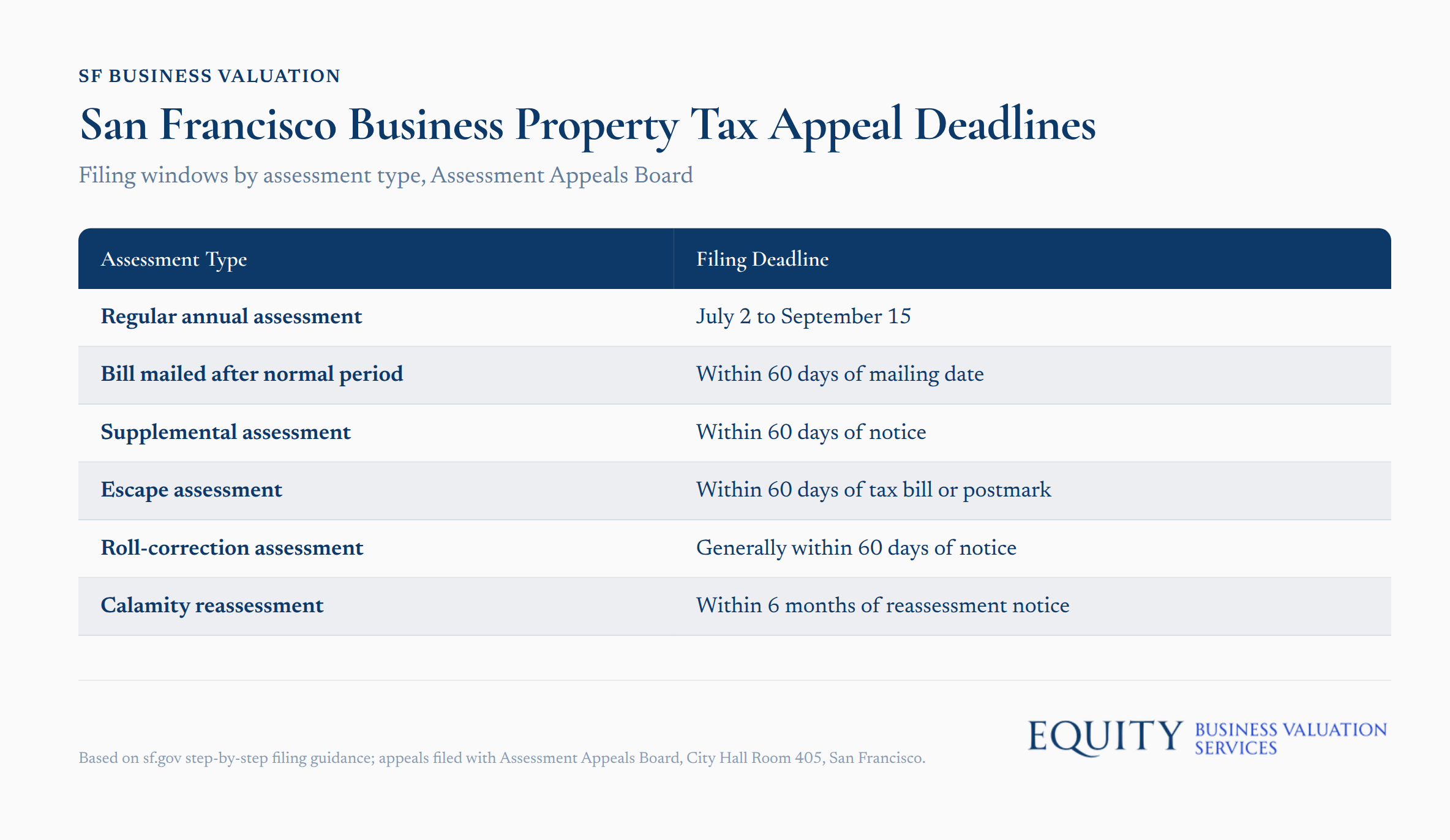
Different assessment types carry different clocks:
| Assessment type | Filing deadline |
|---|---|
| Regular annual assessment | July 2 to September 15 |
| Bill mailed after the normal filing period | Within 60 days of the mailing date |
| Supplemental assessment | Within 60 days of the notice |
| Escape assessment | Within 60 days of the tax bill or postmark |
| Roll-correction assessment | Generally within 60 days of the notice |
| Calamity reassessment | Within 6 months of the reassessment notice |
Appeals are filed with the Assessment Appeals Board at City Hall, Room 405, 1 Dr. Carlton B. Goodlett Place, San Francisco, CA 94102. The Clerk's office can be reached at 415-554-6778 for questions about a specific filing.
What You Need to File: Application, Fee, and Agent Authorization
Filing an appeal requires a completed Assessment Appeal Application, a document the AAB publishes for this purpose, along with a nonrefundable $120 administrative processing fee paid to the City and County of San Francisco. Regular secured and unsecured appeals can generally be filed online while that window is open, but base-year, supplemental, escape, and roll-correction appeals cannot be filed online and must go through the applicable paper process.
If you want an attorney, CPA, or other representative to handle the filing and hearing on your behalf, you also need an Agent Authorization Form. One form is required per application, and it must be renewed every calendar year, so a representative who filed for you last year needs a fresh authorization this year even if nothing else has changed.
Filing an appeal does not pause your tax bill. San Francisco still requires payment by August 31 of the current fiscal year to avoid late-payment penalties, regardless of whether a hearing is pending. If the AAB later reduces the assessment, the City issues a refund for the resulting overpayment.
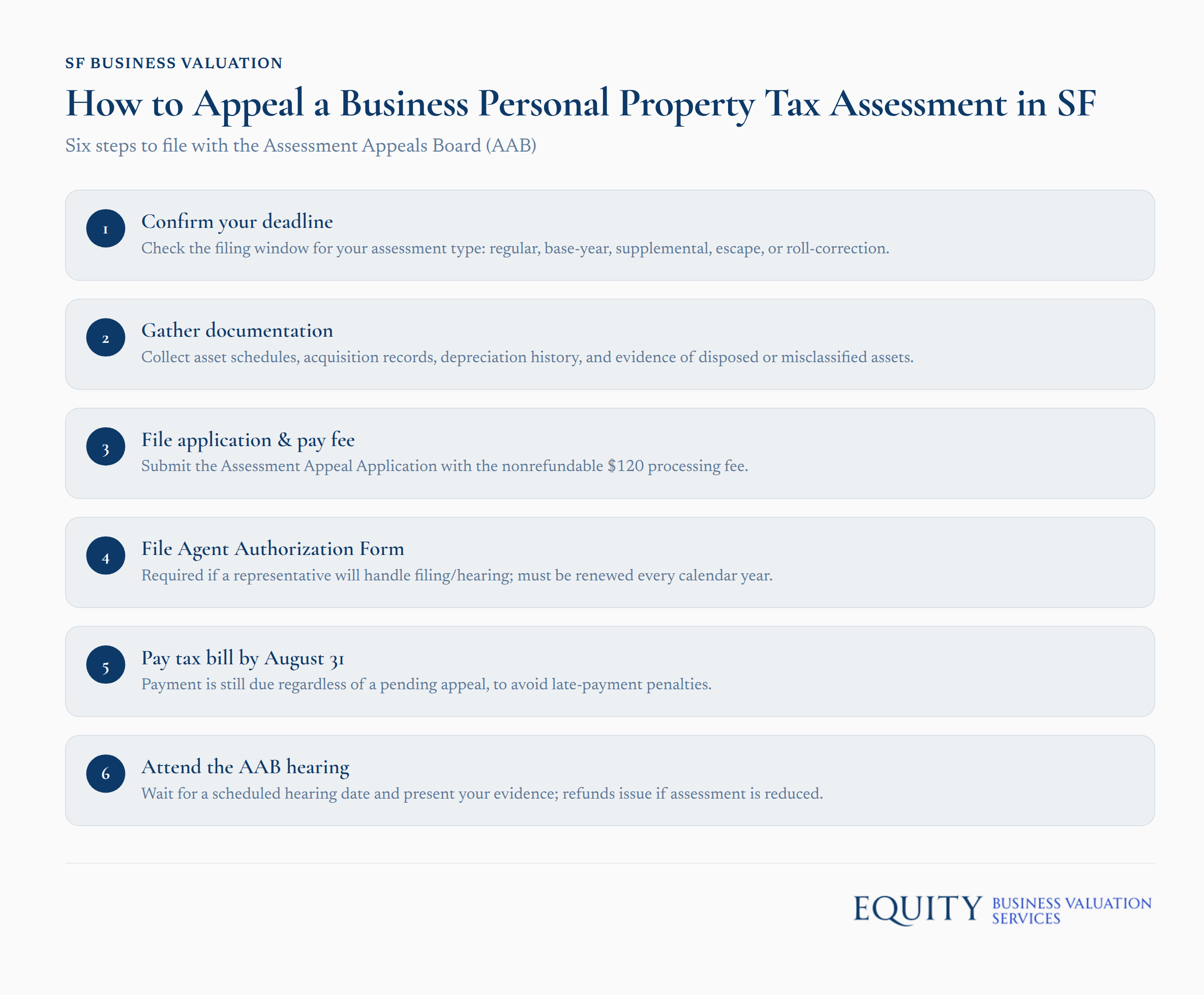
At a high level, the filing sequence looks like this:
- Confirm the deadline for your specific assessment type using the table above.
- Gather supporting documentation, including asset schedules, acquisition records, depreciation history, and any evidence of disposed or misclassified assets.
- Complete the Assessment Appeal Application and pay the $120 processing fee.
- File an Agent Authorization Form if someone else will represent you at the hearing.
- Pay your tax bill by August 31 even though the appeal is still open.
- Wait for the AAB to set a hearing date and prepare your evidence presentation.
What Happens at an AAB Hearing
San Francisco places the burden of proof on the taxpayer, not the Assessor. That means showing up with an opinion that the value is too high is not enough; you need evidence demonstrating the enrolled assessment is incorrect. The hearing itself functions like a mini evidentiary proceeding: both sides present supporting material, and the board weighs it before issuing a decision.
The kind of evidence that actually moves a business personal property appeal includes asset-level detail that the Assessor's mass appraisal never captured: condition at the time of the lien date, actual remaining useful life, evidence of functional or economic obsolescence, and documentation of any disposals or transfers that were never removed from the roll. Simply restating that the bill feels high rarely changes the outcome.
Why an Independent Personal Property Valuation Strengthens Your Appeal
The single biggest difference between an appeal that succeeds and one that gets dismissed is usually the quality of the evidence behind it. Because the Assessor's number comes from a percent-good table applied to reported cost, an independent, asset-specific appraisal is often the clearest way to show that the mass-appraisal figure does not match reality.
A qualified appraisal inspects the actual machinery, fixtures, or equipment in question and develops an opinion of value based on its real condition, age, remaining useful life, and the current market for comparable assets, not a generic depreciation curve. Appraisers working in this space typically hold credentials such as those from the American Society of Appraisers, the International Society of Appraisers, or the Certified Appraisers Guild of America, and the resulting report is prepared in accordance with the Uniform Standards of Professional Appraisal Practice. That combination of asset-specific inspection and recognized methodology is exactly what an AAB hearing calls for.
Because every engagement differs in asset count, record quality, and the depth of analysis the appeal requires, fees for this kind of work are quoted as a fixed amount after we scope the assignment, never billed by the hour. If you are weighing whether an appeal is worth pursuing, our team can help you request an appraisal scoped specifically for an Assessment Appeals Board filing.
Building a Record Before the Clock Runs Out
The biggest risk in this process is not losing a hearing. It's missing the window entirely. Mark the July 2 filing opening and the September 15 deadline on your calendar as soon as your assessment arrives, and start pulling asset records well before that date so you have time to commission an independent valuation if the evidence supports one. A well-documented appeal filed on time gives you a real shot at a corrected assessment and a lower bill going forward.
This article is provided for general informational purposes only and does not constitute legal, tax, or financial advice. Readers should consult a qualified attorney or CPA regarding their specific circumstances.